Welcome to the third article in my new series where I dip into my collection of absinthe, sample and discuss a single bottle and its producer, likely talk excessively about myself, and indulge in many an awkward tangent along the way! Please feel free to comment and yell at me for any factual mistakes that I make and I’ll get them cleaned up asap!
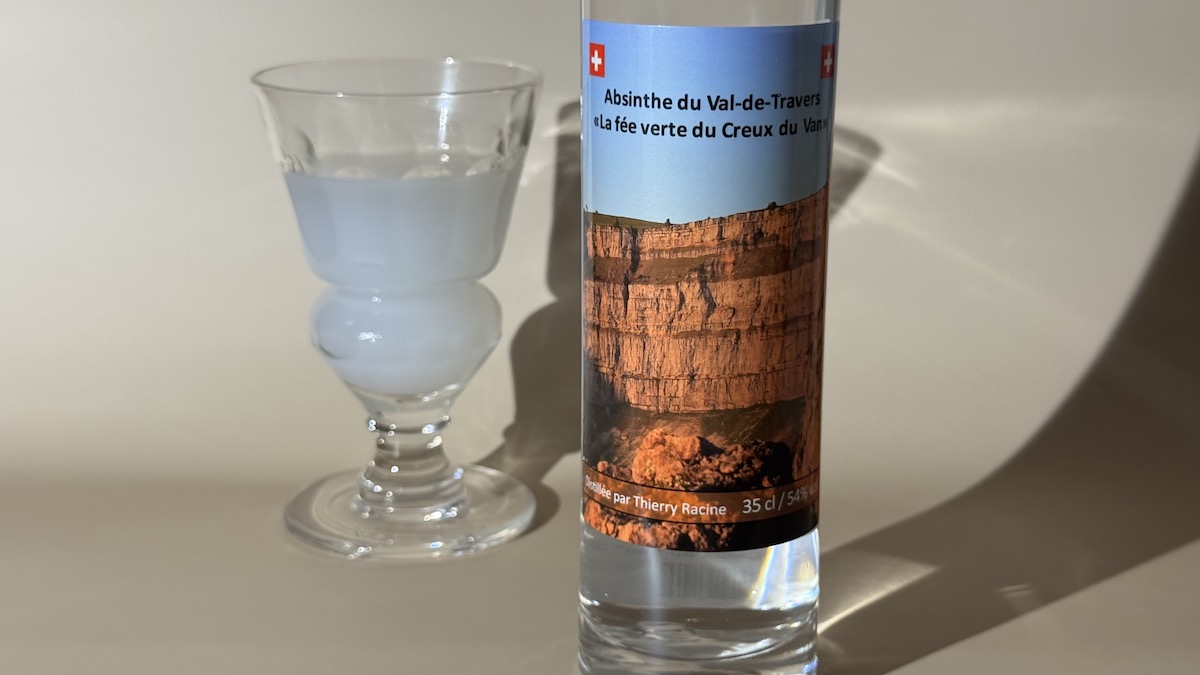
Today we’re going to try another delicious Swiss blanche from the Val-de-Travers region, the lovely La Fèe Verte du Creux du Van by Distillerie Bovet Racine in Fleurier, Switzerland.
Intro
In my previous post I recounted a recent trip where Sabrina and I picked up an armful of bottles from an absinthe shop in Motiers, Switzerland to bring back home to the states with us. La Fèe Verte du Creux du Van was one of them. I can’t recall why I chose it, whether it was a recommendation from the shopkeep or if I was attracted to the bottle’s simple label decorated with a photo of a cliffside rather than the more traditional illustrated artwork of a fairy or some other feminine-shaped humanoid. I also confessed in that post that Sab and I had already spent much of that afternoon sampling absinthe, and so whatever powers of reasoning I’d conjured to choose this bottle over others, well, I abruptly forgot what they were. Nonetheless, I picked wisely. It’s a wonderful bottle and another fine example of a Swiss blanche, or La Bleue, from the famed valley where absinthe was born.
One thing that’s becoming clear with many of these Val-de-Travers distilleries is that when they claim to adhere to traditional processes, they’re not just talking about production. They’re traditional in all aspects of their craft. They very much remain small localized shops of just a few people inside small Swiss villages of not so many people either, with a focus solely on their art and their ancestry. They certainly don’t have a social media budget or brand specialist or an SEO strategy. Hell, from what I can tell, the Bovet Racine distillery doesn’t even have a website. And I love that so much. It’s all very endearing to this here brand-saturated city boy born and raised in the corporations of the U.S. of A.
Bovet Racine’s minimal online presence made it all the more fun trying to gather interesting info on them. I pieced together what little I could find, and ended up not only learning a little bit about the Creux de Van absinthe and its maker, but also getting a lesson on the wonderful little slice of Switzerland that the bottle celebrates.
Sabrina’s Swiss mother will be so happy to learn that her yankee-ass son in law is getting some culture!

The Absinthe
La Fèe Verte du Creux du Van is an absinthe produced by the Bovet Racine distillery in Fleurier, a small village in the Val-de-Travers region in the Swiss canton of Neuchàtel. It’s a blanche, or clear-colored, absinthe, meaning that it does not go through a secondary coloring step during production. Historically, absinthes from this region tended to be blanches, since it was easier to pass off an illegal clear-colored absinthe as a different legal spirit back during the years of the Swiss absinthe ban and its corresponding decades of clandestine distilling.
At 54% ABV, it’s on the lighter side, with most absinthes falling somewhere within 45% ABV to a whopping 74%. I couldn’t find any documentation to indicate what specific botanicals are included in this absinthe outside of the usual cast of characters (wormwood, anise, fennel, etc), but whatever they are, I would expect that they’re all sourced locally, as the bottle art, as well as its contents within, all serve as an homage to its surrounding area.
Speaking of the bottle art, let’s take a look at the absinthe’s name at the top of the label: La fée verte du Creux de Van, which translates to “The Green Fairy of Creux de Van.” Note that La fée verte (“The Green Fairy”) is, of course, a common nickname for absinthe, and not a reference to a “verte” absinthe, or a green-colored absinthe. Since this is a blanche absinthe, not a verte.
But for those who are less geographically-inclined like myself, what’s a Creux de Van?
Creux de Van is a massive limestone amphitheatre in the Jura Mountains right above Val-de-Travers, running nearly a mile across with sprawling cliffs that rise 160 meters (525 feet) above the valley floor below. “Creux” roughly translates to “hollow” or “basin”, and “Van” is an old regional word that refers to the enormous bowl-shaped canyon carved into the mountain.
The Creux de Van is one of Switzerland’s most famous natural landmarks, nicknamed the “Grand Canyon of Switzerland” by.. ehh…well.. presumably an American.
So, to put it all into context, the Jura mountains are the mountain range that marks a large part of the Swiss-French border, Val-de-Travers is the valley in the mountains known as the birthplace of absinthe, Fleurier is a village in the valley where the Bovet Racine distillery is located, and Creux de Van are the cliffs overlooking the valley.
Fun fact: the Jura mountains are where the term “Jurassic” comes from.
Bovet Racine’s distiller Thierry Racine spent his summers as a kid in Creux de Van, and this bottle is his tribute to the area. The cliffs in the photo on the label are indeed the cliffs of Creux de Van.
In a profile on Thierry on the Maison De l’Absinthe website, it says that one of his absinthes “draws direct inspiration from a recipe passed down by his great-uncle, who distilled it in the Creux-du-Van region.” So presumably they’re referring to this bottle.
In fact, the label on the back of the bottle states, “Apéritif de qualité, élaboré de façon artisanale par d’anciens distillateurs d’absinthe,” or “A quality aperitif, handcrafted by former absinthe distillers” which seems to imply that this recipe dates back to the old Swiss moonshining days sometime during the near-100 year span when absinthe was banned (1910-2005).

The Maker
Bovet Racine was founded by Thierry Racine (the main distiller), Sylvie Bovet, Christophe Racine, and Fritz Delachaux. The operation started in 2006, a year after Switzerland legalized absinthe.
While information on the distillery is fairly sparse, most of it tends to highlight Thierry Racine, the master distiller and public face of the company. His distilling journey began with relatives from the clandestine era passing down their knowledge and schooling him in the absinthe arts. Interestingly, one of the other four founders of Bovet Racine, Fritz Delachaux, is referred to as a “former clandestine distiller” in online profiles, but it’s unclear if Fritz is any relation to Racine’s clandestine distilling ancestors or not.
The other Racine who co-founded Bovet Racine, Christophe Racine, eventually left the company to start up his own operation, Distillery du Val-de-Travers, in the nearby village of Motiers. Needless to say, as I was reading up on the many distilleries throughout Val-de-Travers, with most of the info coming from spotty English translations of French-speaking websites, I’d find myself tripping over these two different absinthe houses run by two different Racines in the same valley.
Same with Bovet. Sab and I had visited another delightful absinthe distillery, Bovet La Valote, during our past visit to Motiers, and I wondered as to the relation between that Bovet and this Bovet in Bovet Racine. There appears to be none. Well, I’m sure they know each other, but that would seem to be the extent of it. I’ve since learned that Bovet is just a common family name in this area, similar to “Smith” here in the states. Makes sense.
And so here I am, gaining small insight into French-speaking Swiss tradition, language and landscape, slowly but surely becoming a minutely more cultured fellow with every glass of absinthe. I knew this stuff was good for me.
As I said earlier, with Bovet Racine being a local operation without a significant online footprint, there’s not a whole lot to gather from the internet. But fortunately, the bottle of Creux de Van speaks for itself, telling a story about a small, superb Swiss distillery born from the knowledge of clandestine distillers of the past, and a love for the beauty of its majestic mountainous home today.

Random Deep Dive… Does Absinthe Make you Hallucinate?
Ok, while we’re still here and still talking about absinthe, let’s veer off on a quick tangent and tackle a question that often pops up from folks who are new to the spirit:
Does absinthe make you hallucinate?
Short answer: Nope. Sorry to disappoint.
Absinthe does not make you hallucinate. It’s an urban myth.
In fact, the main psychoactive ingredient found in absinthe is something called… yep… alcohol. If you drink enough of this ingredient, you won’t hallucinate, but you will become temporarily weird and likely annoying, also known as drunk. I can confirm based on my numerous personal experiments in the name of science.
Absinthe generally has a high ABV (alcohol by volume) compared to other spirits, and this has perhaps led people to think they’ve experienced something more intense than regular old drunkenness. But they didn’t, they were just drunk.
If you see an absinthe bottle that promotes its hallucinogenic properties based on its high levels of thujone, you can rest assured that it’s not only a bogus claim, but it’ll be a shitty tasting fake absinthe (“fauxsinthe”). Legit absinthe producers (like the ones in Val-de-Travers) will never mention thujuones.
Thujone is a real thing, though. It’s a naturally occurring compound found in the essential oils in wormwood. Wormwood (Artemesia Absinthium) is, of course, one of the key botanicals in absinthe, and also, where absinthe gets its name. Thujone is what folks will unscientifically claim makes you hallucinate, or even more nefariously, makes you lose your mind. And it is, in fact, potentially neurotoxic at high levels. Like, very high levels. Like, if you tried to drink enough absinthe to feel any effect from the thujone, you’d die from all the alcohol first.
A lot of this goes back to the nineteenth century heyday of absinthe, when absinthe cafes dotted the French city streets and the “Green Hour” was a common pastime. Along with absinthe’s booming popularity, there was a growing movement against it.
A French psychiatrist named Valentin Magan argued that absinthe caused a specific illness called “absinthism,” which was distinct from your run-of-the-mill alcoholism, and which he connected to seizures, madness, hallucinations and general social dysfunction. His diagnosis came out of his animal experiments where he’d compare the effects of alcohol on them with those of concentrated wormwood. These tests were flawed, to say the least, as the doses of concentrated wormwood that the poor animals received was a ludicrously larger amount than one could ever receive from drinking absinthe. In hindsight his tests merely proved that shooting an animal up with high doses of concentrated botanicals is not gonna be good for it. And is an asshole move.
Bogus tests or not, they did succeed in striking a massive blow to absinthe’s reputation. The studies, along with an aggressive pounding by the powerful temperance movement and a wine industry motivated to remove its competitor, not only led to an eventual absinthe ban, but also a long-standing worldwide belief that absinthe has the power to do far more to you than just get you drunk and/or hungover. But it doesn’t.
Modern chemical analysis confirmed that pre-ban bottles of absinthe contained far less thujone than what was originally believed, and well within the limits of safe consumption, and it’s now commonly understood that the symptoms previously attributed to “absinthism” were simply the results of plain ole heavy alcohol use, exaggerated scientific studies, and anti-absinthe propaganda. Not some hallucination-causing thujone boogeyman.
Sab and Bones say:
Drinking a 3:1 water-to-absinthe ratio with no sugar…
“A pretty, cloudy white louche. Bold, spicy taste up front with a pleasing, mellow after taste, like spicy oregano.”

Sab
“A beautiful swirling cloud at the start of the louche, like a spinning galaxy, ending in a brilliant milky white. Medium light, soft body with a silky smooth mouthfeel. A bitterness that hits you right up front and in the back, almost at the same time, but in a comforting way. Nice anise flavor without being overly anise-forward. A pleasant mintiness drifts through, as well. Delightful.”

Bones
Sources and Suggested Reading
Maison de l’Absinthe – Bovet Racine profile
Maison de l’Absinthe (French) – Distillerie Bovet Racine
Maison de l’Absinthe – La Fee Verte du Creux de Van
<< Previous (La Clandestine Blanche)
Next (Coming Soon) >>
Leave a Reply