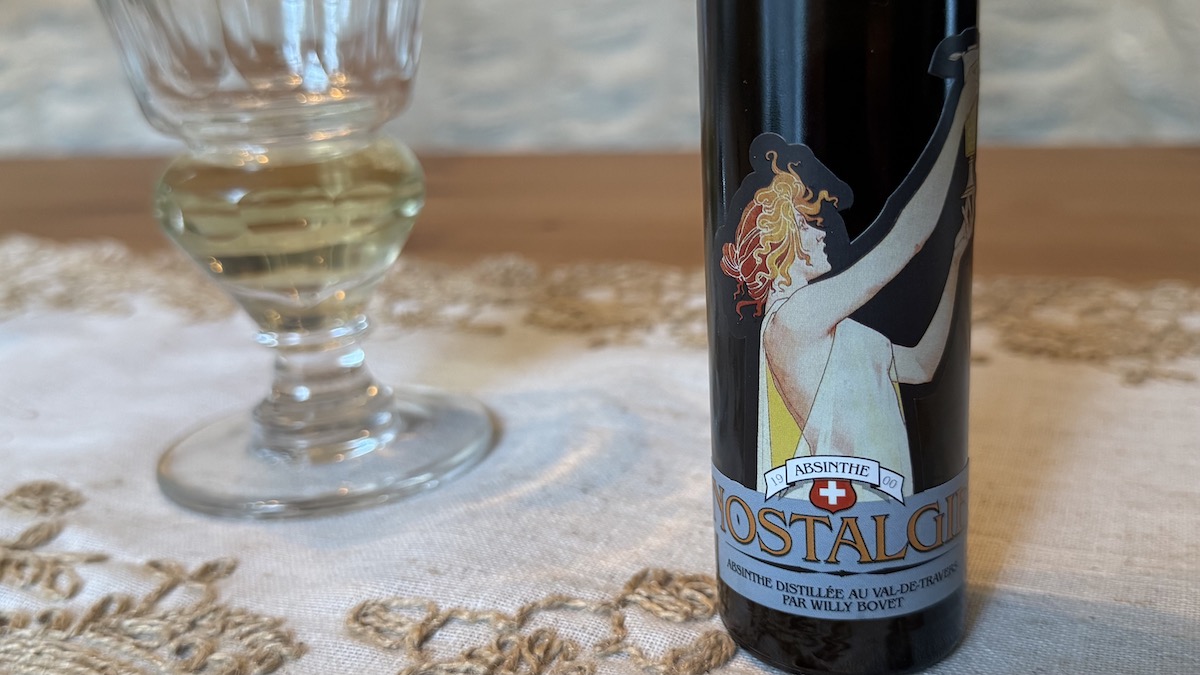
Welcome to the first article in my new series where I deep dive into my collection of absinthe bottles, one at a time, to give myself an excuse to have a drink, to add more to the collection, and to learn some stuff in the process. With each post, I’ll discuss the absinthe and the distiller, likely talk way too much about myself, and then awkwardly veer off into adjacent topics, because awkward is what I do. Let’s start things off with a limited edition bottle from Absinthe Bovet La Valote in Motiers, Switzerland, the delightful Absinthe Nostalgie!
Oh, and if I mistakenly post any incorrect information, please yell at me in the comments and I’ll fix it immediately and we can pretend like it never happened.
Intro
My wife Sabrina is from Switzerland, and we make a trip to visit her family out there a couple times a year. As you would expect, it’s not a bad place to go for a visit to the in-laws, especially for a fellow that loves absinthe.
Absinthe, that legendary anise-flavored high proof spirit that is surprisingly still (falsely, mind you) regarded more for its hallucinogenic properties than for its artistry, sophistication, and history, was born in Switzerland in the late 18th century, and Switzerland remains one of the best places worldwide to find excellent hand-crafted bottles of the Green Fairy.
Last July we took a train from her parents’ place in the Swiss German-speaking part of Switzerland over to Motiers, a charming little village in French-speaking Val-de-Travers, the famous valley in the Jura mountains that is known as the birthplace of absinthe.
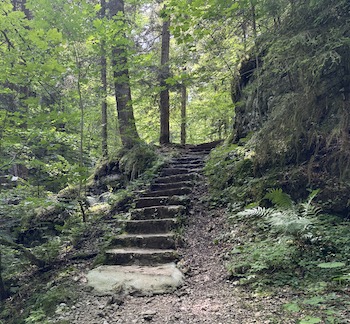
Upon arrival, we hiked the beautiful gorge outside the village, following the trails deep into the forest and keeping an eye out for one of the bottles of absinthe famously hidden out there (we didn’t find any). We then visited the magnificent Maison d’ Absinthe (Absinthe Museum) in town for some history and an absinthe tasting. Then we popped into the local distillery, Absinthe Bovet La Valote. We were greeted warmly by Francoise Bovet, owner and distiller.
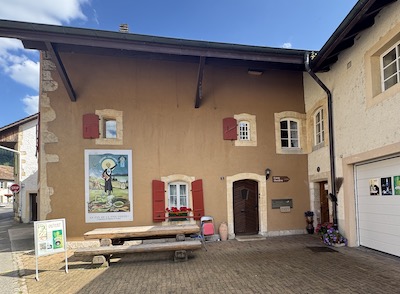
Francoise was awesome. She was happy to share samples of their product along with the history of the distillery, despite the fact that we had showed up unexpectedly and couldn’t speak a lick of her language, French. Luckily, Sab and Francoise were able to find a common language in Swiss German, and Sab would translate back to me while I stood there stupidly, sipping absinthe and probably awkwardly proclaiming “Es Bueno!” in Spanish because I choke under pressure.
If I recall, Francoise even mentioned that she was due to take a walk into the forest to replenish the bottles out there. Hell yeah.
We flew back to the states with a few bottles from Bovet, one of which was the Nostalgie. A wonderful absinthe and a perfect one to kick off this new series. So let’s do it…
The Absinthe
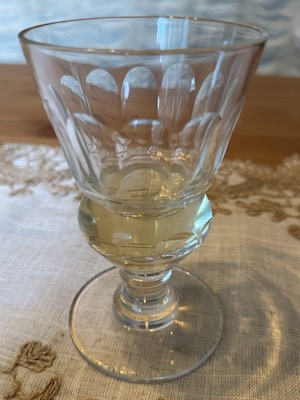
Absinthe Nostalgie is a limited production batch, hand crafted according to tradition and a family recipe in a small ancestral still that outputs just 18 litres (less than 5 gallons). It is produced with greater wormwood and petite wormwood, hyssop, and lemon balm, and then aged in oak casks which gives it a unique, warm amber color and hints of wood.
Nostalgie is packaged in an opaque matted bottle, which, as Bovet explains, is to protect the spirit within from UV light, which I presume is to preserve the color. They cleverly left a vertical strip of non-matted “window” to allow you to see how much absinthe you’ve still got in there.
It’s worth noting that cask aging is not necessarily a standard practice in modern or historical absinthe production, but it certainly happened. According to the back label on the bottle, Nostalgie is, in fact, inspired by the oak aging processes used by some distillers of the region back in the late 19th/early 20th century. And thus the name, Nostalgie.
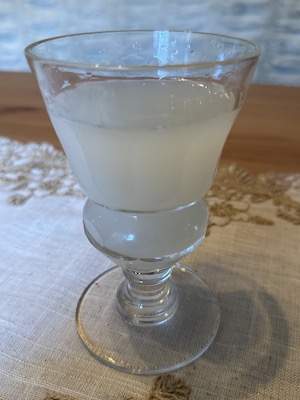
Speaking of colors…
If oak aging isn’t a common practice, then amber isn’t a common color for absinthe, either. Indeed, absinthe is typically, but not exclusively, labeled as either verte or blanche in color. Let’s discuss that real quick…
Verte is a green-colored absinthe; the color that is most often associated with absinthe, and historically associated with absinthe from the French Belle Epoch era. This green color is, of course, where absinthe gets its nickname, “La Fee Verte” (The Green Fairy), and why 19th century Parisians would gather at absinthe cafes at day’s end to celebrate the “Green Hour”.
Verte absinthe is green because, after initial distillation, it goes through a secondary coloring step where the spirit is macerated with plants containing chlorophyll.
Blanche is a clear absinthe, colorless because it goes into the bottle after distillation, bypassing the coloring step. Historically, blanche absinthe is associated with Switzerland, especially during the long prohibition years because a clear absinthe could be much more easily disguised as one of the legal spirits of the day than a bright green one could. A clandestinely produced blanche absinthe of that era was also called “La Bleue.”
That’s a very generalized and a very loose take on coloring. And as we continue along this series, we’ll see examples of other colors (red absinthe, for instance) and probably even some examples of “fake” absinthes (or “fauxsinthe”) made green with artificial coloring.
Suffice it to say, though, that a small batch, oak-aged, amber absinthe, is a special absinthe.
The Maker
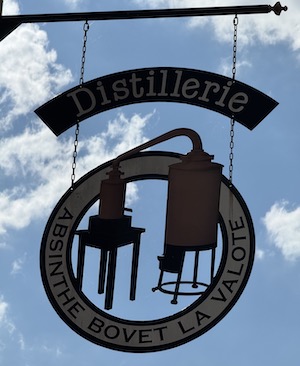
The origin of distillery Absinthe Bovet La Valote starts back in the late 1960s, smack dab in the middle of Switzerland’s almost century-long prohibition on absinthe. Willy Bovet was a watchmaker by trade who got his hands on an old absinthe still and started home distilling in Val-de-Travers. Over the years he became highly regarded in clandestine absinthe circles, known for saying “L’absinthe c’est une vie!” (“Absinthe is a life!”).
When Switzerland legalized absinthe in 2005, Willy moved out of the underground scene and started up his legitimate operation in Motiers, continuing his focus on localized, artisan absinthes.
He passed his knowledge down to his daughter, Francoise, who took over the business in 2010, and continues the tradition of producing small batch, hand crafted absinthe to this day.
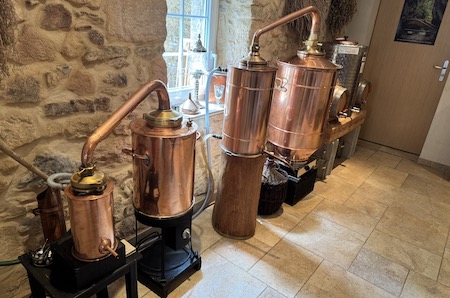
Also staying true to tradition, the plants used in Bovet absinthes are grown right there in Val-de-Travers, harvested by hand, cleaned, bundled and dried. Francoise herself participates in the harvest, and then distills them in small, limited batch stills, including the one that Willy used back in the 70s.
A Brief Dive Into Prohibition…
There are so many things to discuss around absinthe – its legitimate history, its not so legitimate mythology, its ingredients, its production, etc – so let’s just plan to dive into individual topics as we continue throughout this series. But since I’ve mentioned the clandestine absinthe culture above, let’s do a real high level run-through of how this falls into absinthe’s history timeline…
Absinthe originated in the Val-de-Travers region of Switzerland in the late 18th century. Like plenty of other spirits, it was initially produced for medicinal purposes before catching on as a recreational drink. It soon hopped over to neighboring France, exploding in popularity during the 19th century Belle Epoch era.
By late 19th century, it had earned its fair share of enemies, from the growing temperance movement who had made absinthe its primary target, to the massive wine industry looking to take out their main competitor, especially after incurring such huge losses from the Great French Wine Blight.
The anti-absinthe machine was soon in full effect with newspapers publishing scientific studies showing that absinthe will make you crazy (these have subsequently been debunked), marketing materials associating absinthe with death, demons, all the bad stuff. Basically, all the propaganda tools at the time were trained on absinthe.
Then in 1905, a Swiss laborer and alcoholic named James Lanfrey came home, drunk and delirious from a day of non-stop heavy boozing, and murdered his pregnant wife and two daughters. The incident became a news spectacle, framed as the “Absinthe murders” despite the fact that, along with absinthe, Lanfrey had also pounded a colossal amount of whiskey and wine. This was the death knell for absinthe, and Switzerland banned the production and sale in 1910.
Prohibition, however, did not stop the absinthe culture in Val-de-Travers. Producers just closed up their commercial stills and quietly distilled on the down low in their homes, barns, etc. And absinthe drinking didn’t stop either, folks just started buying it on the down low from their “friends.” Local law enforcement turned a blind eye on it rather than harassing good folks in their districts.
And thus began the quiet, subdued Swiss clandestine absinthe culture that continued through the entirety of prohibition until it officially ended in 2005, with Switzerland legalizing absinthe for the first time in almost a century, allowing formerly underground distillers like Willey Bovet to bring their talents out into the light.
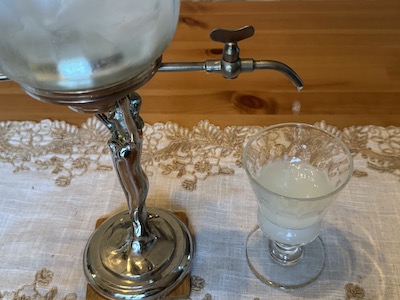
Bones and Sab say:
Drinking a 3:1 water-to-absinthe ratio with no sugar…
“A very nice, light mouthfeel with strong anise that lingers long after swallowing. Cozy and warming. Delightful.”

Sab
“A lovely, cloudy, yellowish-white louche. Smooth, silky, light mouthfeel with a blast of minty sweetness and big anise up front followed by a pronounced and welcome bitterness in the back that lingers for a while in a good way. Very enjoyable and fairly bold at 3:1, but felt right to me. A great bottle, and worth lugging back home to the states with my dirty laundry.”

Bones
Sources and Suggested Reading
Absinthe Bovet La Valote website
Absinthe Nostalgie product page
Leave a Reply