Welcome to the second article in my new series where I dive into my collection of absinthe bottles to give myself an excuse to drink absinthe, expand the collection, and maybe learn some new stuff in the process. With each post, I’ll discuss a bottle and its producer, likely talk way too much about myself, and indulge in many an awkward tangent along the way! Please feel free to comment and yell at me for any factual mistakes that I make and I’ll get them cleaned up asap!
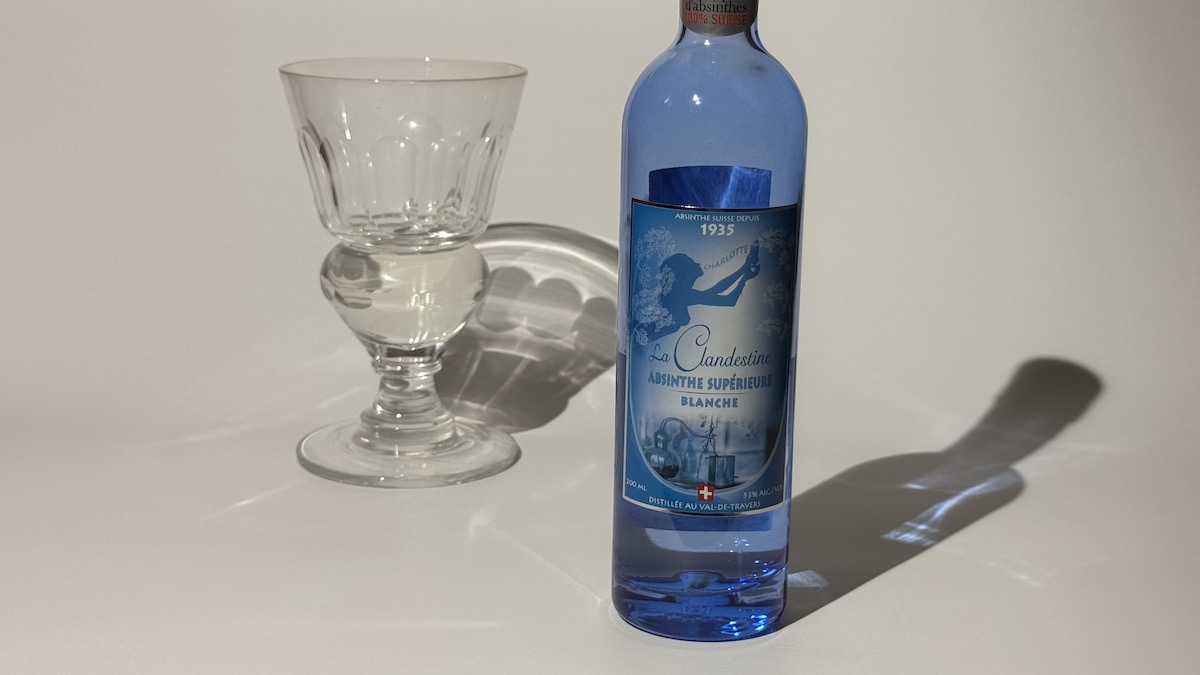
Today let’s take a look at the well-known, much loved, award winning absinthe from Distillerie Artemisia in Couvet, Switzerland, La Clandestine Blanche.
Intro
When Sabrina and I were visiting Motiers, Switzerland for an afternoon of absinthe sampling, we ended the day at a local absinthe shop to pick up a couple extra bottles before catching our train. The store was, man, just shelf upon shelf of absinthe bottles, most of which I’d never heard of. It was glorious. And a little overwhelming for me, an absinthe lover but certainly no scholar.
There were so many to pick from, and we had limited time before our train would arrive to take us back to Neuchatel, and well, I was operating on a pretty decent absinthe buzz already. The pressure was on. I felt like I was on that 90s game show Supermarket Sweep, as I rapidly navigated my way down the aisles, trying to pick out only the great stuff that was unique to the region and not available back in the States.
(If you’re not familiar with Supermarket Sweep, by the way, congrats on not being old)
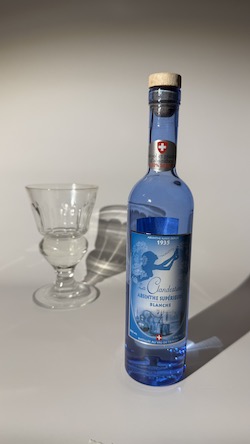
I spotted a bottle of La Clandestine Blanche. Hmm, that bright blue bottle with the enigmatic silhouette of a woman triumphantly holding an absinthe glass looked pretty damn familiar. Produced just a train stop over in Couvet, it would certainly serve as a great representation of the Val-de-Travers region’s absinthe lore. So I snagged a bottle, we rang it up with the others, and we headed to the train station, and I didn’t think about it again until we got back home to Georgia.
In hindsight, of course, that bottle looked familiar to me because it was familiar. La Clandestine is a very well-known absinthe, noteworthy in modern absinthe history, and, well, available for sale at the liquor store a mile and a half from my house in Decatur, GA. Oops.
Note to self – next time you go bottle shopping in Val-de-Travers, plan to do so before you spend the afternoon drinking absinthe.
So anyway, I failed at acquiring absinthes only available in the area. But I nonetheless succeeded in taking home an absinthe directly from the valley in which it originated years ago and where it continues to be produced to this day. So, that’s a win in my book. Not to mention, it’s a damn delicious absinthe.
Sab and I are heading back to Switzerland at the end of summer with a plan to train over to Couvet this time, so hopefully we can have ourselves a drink of it straight from the source, the Artemisia distillery.
The Absinthe
La Clandestine Blanche is, as the name would suggest, a blanche (clear) absinthe produced in Couvet, Switzerland. Couvet, part of the French-speaking Val-De-Travers region of Switzerland that borders France, is considered the birthplace of absinthe. All the ingredients in La Clandestine are local to this area, including the grande and petit wormwood, hyssop, and lemon balm. Even the neutral spirit that the distillery sources is 100% Swiss. This is a locally produced Val-de-Travers absinthe through and through.
The name “La Clandestine” is a celebration of the underground distilling tradition in Switzerland that existed throughout the entirety of the country’s absinthe ban from 1908 to 2005 (Check out my previous post for more on the prohibition). The recipe for La Clandestine actually dates back to a recipe from 1935, nearly 30 years into the prohibition, by a clandestine distiller named Charlotte Vaucher who made this absinthe for years in a locked-off room in her house.
In the early 2000s, Charlotte’s nephew passed the recipe on to a Val-de-Travers local named Claude-Alain Bugnon, who himself was just getting into the whole underground distilling game. Bugnon went on to produce his own bootleg absinthe from the recipe, initially calling it “Charlotte la Clandestine” in honor of its original bootlegger creator. When the Swiss ban on absinthe was finally lifted in 2005, La Clandestine became one of the first absinthes in the Val-de-Travers region to be legally distilled.
Thus, when you have a drink of La Clandestine, you’re not only tasting a nearly century-old recipe, but you’re tasting an absinthe developed by an early generation Swiss moonshiner and then later passed on to a new (and essentially, final) generation Swiss moonshiner. A passing of the torch across multiple decades that was responsible for keeping this historical underground absinthe alive and well, until it could ultimately be passed along to the rest of us.
La Clandestine, in its lawful, post-clandestine years, has amassed an impressive stack of awards and accolades, including numerous Golden Spoon awards at Les Absinthiades, the annual absinthe festival in Pontarlier, France.
The Maker
La Clandestine is produced by Distillerie Artemisia. Its founder and master distiller, the previously mentioned Claude-Alain Bugnon, grew up in the Val-de-Travers region, and unlike many in the area, did not come from a distilling family. In fact, he originally worked in the oil refining industry before setting off on his underground absinthe journey in 2000. He would go on to spend the final five years of prohibition producing small batches in his basement, learning the techniques and following in the clandestine tradition of Swiss bootleggery.
After almost a century of illegal absinthe production taking place in the region, Bugnon was to become one of the last in a long line of outlaws before him. When Switzerland legalized absinthe in March of 2005, Bugnon brought his operation out of the shadows and founded Artemisia as one of the first legal absinthe distilleries in the region. Bugnon was, indeed, the first in Couvet to complete the federal licensing process, establishing a path for other underground distillers to follow and becoming a leading figure in the transition from clandestine to legal production.
Nowadays, 20+ years after legalization, Claude-Alain is still making absinthe in Couvet, running Artemisia with his wife, Karine, and with their son Sebastian who is learning the ropes to one day take over the operation.
Absinthe… a brief primer
So we’ve talked about absinthe producers, but we haven’t really gone into absinthe production. What exactly was Bugnon doing in his basement all those years as he was refining his craft? Or, to put it more generally, how do you make absinthe?
Well, at a very high level, you start with a base neutral spirit. Unlike, say, a whiskey that must come from a grain-based alcohol in order for it to be classified as a whiskey, absinthe doesn’t really care what it starts as. The neutral spirit can be made from grain, grapes, sugar, or whatever the hell else the producer has access to.
Then you soak, or macerate, your botanicals in the spirit. There are many types of botanicals that can be combined to make up an absinthe, and it’s this particular combination and ratio of botanicals that makes each absinthe unique, but all absinthes will at least include the “Holy Trinity” of wormwood, anise, and fennel:
- Grande wormwood (Artemisia Absinthium) gives the absinthe its bitterness, herbal complexity, and a distinctive earthy character. It’s also where the name “absinthe” comes from.
- Anise contributes that black licorice aroma that is a critical character of absinthe and also responsible for turning many people who don’t like black licorice away from the drink
- Fennel adds a delicate sweetness and spice, and softens the intense anise aroma and wormwood bitterness
Additional herbs include, but are not limited to, hyssop, lemon balm, petite wormwood, Angelica root, Veronica, mint, and coriander.
Macerating these botanicals will extract their flavors and aromatic oils into the neutral spirit, thereby making it not a neutral spirit anymore. Then it will be re-distilled, producing a new spirit with bright, clean, integrated herbal flavors.
This newly formed spirit is your absinthe. A blanche, or clear, absinthe. At this point, it’s just about good to go unless you want to make it green.
To transform your blanche into a verte (green) absinthe, the kind that we often associate with the French Belle Epoque era, you’ll need to put it through a coloring step via a secondary infusion of herbs like hyssop, petite wormwood, and lemon balm. The chlorophyll from the herbs will naturally introduce that iconic green coloring along with some additional new herbal aromatics.
Because blanches do not go through this secondary infusion phase, they’re often characterized by softer, more delicate flavors than vertes.
Finally, the spirit will be diluted with water as necessary to get it to an ABV between 53 and 72%, and then bottled.
Sab and Bones say:
Drinking a 3:1 water-to-absinthe ratio with no sugar…
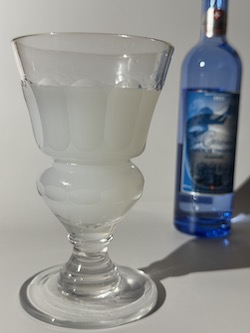
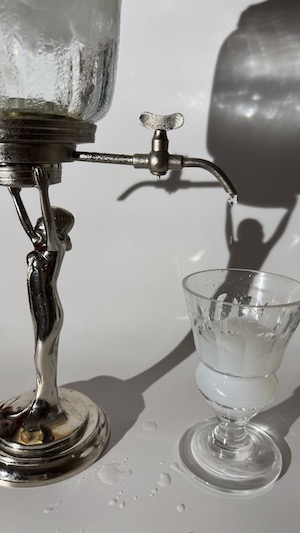
“La Clandestine has a delightfully cloudy white and milky appearance. Warm and mellowing taste. Soft mouthfeel, with a big bitter bite on the back of your tongue and a bold but pleasant anise flavor. I like it!”

Sab
“A clean, bright milky white louche. Soft silky mouthfeel with a medium to lightish body. I get a fairly sharp wormwood bitterness and a minty bite right up front that tickles my tongue and makes me pay attention. Anise is prominent but also nicely balanced by the complementing mint flavors. Bitterness fades quickly and I’m immediately ready for another sip. Really great stuff. Hope we can try it straight from the source this summer!”

Bones
Leave a Reply