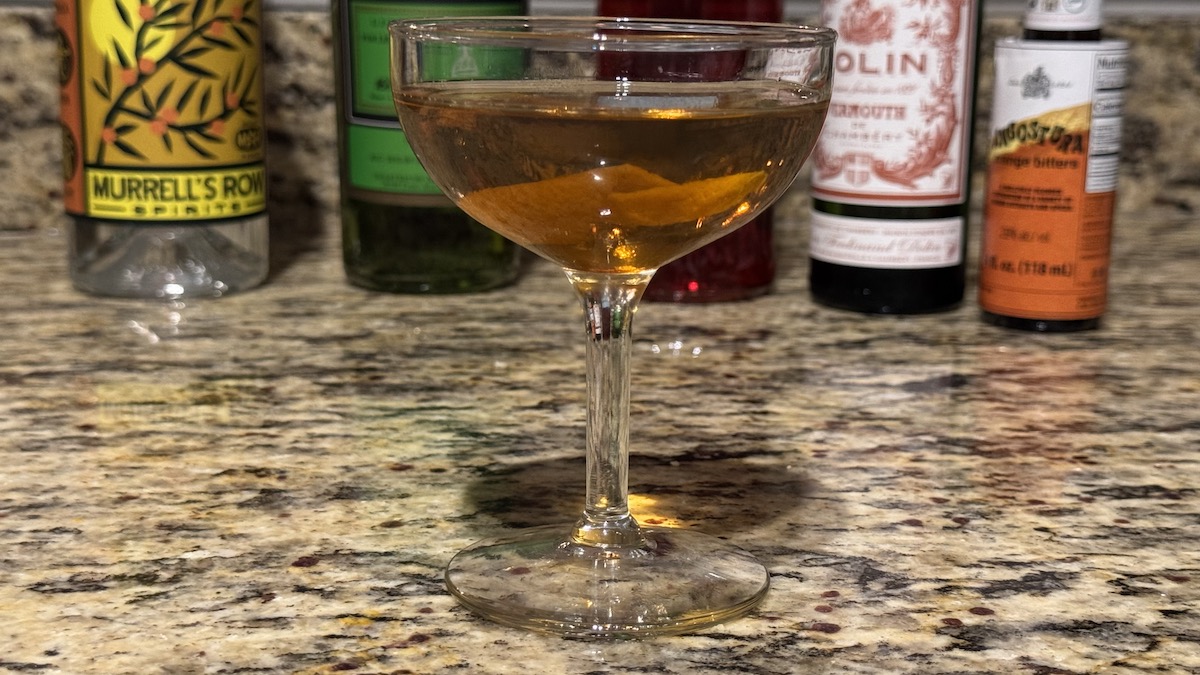
The twenty-seventh entry in the series where my wife Sabrina and I journey through the wide wonderful world of classic cocktails by crafting and drinking recipes together at our home bar. Today let’s break out the Chartreuse again and explore this elusive cocktail born from the Bijou, the Tailspin.
Recipe:
- 1 oz Murrell’s Row Gin Gin
- 1 oz Dolin Rouge (Sweet) Vermouth
- 1 oz Green Chartreuse
- 1 dash Angostura orange bitters
- Campari rinse
- Garnish: Orange twist
Rinse a chilled coupe or Nick & Nora glass with Campari, and then dump (or drink) it. Add gin, vermouth, Chartreuse and orange bitters to a mixing glass with ice and stir until chilled. Strain into the glass and garnish with an orange twist.
Intro:
So, the Tailspin has turned out to be one of the more confusing cocktails from my list of “classic cocktails” that I’ve made so far. It’s not the recipe that’s confusing. That’s straightforward and… actually, no it’s not. The recipe is confusing, too. But we’ll get to that later. The drink itself is what’s confusing me. Because I have no idea why it’s on my list.
As I’ve mentioned numerous times, when I started my “Making Classic Cocktails at Home” exercise last year, I simply rattled off every cocktail I could pull from memory and deemed that I shall make each one (and blog an unnecessarily excessive amount about each one too). It was a simple premise that yielded a list of drinks spanning the range from “true vintage classics” to “names I probably recognize because I heard them in Tom Cruise’s ‘Last Barman Poet’ monologue from Cocktail a thousand years ago.”
Tailspin doesn’t really fall into either of these categories, and I have no idea why it’s on my list. I don’t recognize the name nor do I recognize the recipe nor do I even remember adding it to the list. There’s also a surprisingly limited amount of information about it over at most of my regular reads on the internet, compared to almost every other cocktail that I’ve researched. And the recipes that I did pull online were all over the place.
This is not likely a drink that I stumbled upon at some point in my life. I don’t know why it’s on my list, but I have to assume I just saw it while flipping through a cocktail book and figured a drink named “Tailspin” must be popular as either a rum-based tropical drink or at least one of the tried and true, beloved plane-named cocktails like the Aviation, B-52, Paper Plane, etc. But nope, it’s neither of those.
From what I can tell, it’s just a confusing cocktail with a name that feels strangely arbitrary with regards to its recipe, and a recipe that feels, well, also strangely arbitrary.
Booze Basics:
Not only is my relation to this drink a mystery to me, but the recipe for this drink ain’t exactly crystal clear either. As I said, many of the larger cocktail resources on the internet don’t acknowledge the existence of the Tailspin, and the recipes that I could find only confirmed that it’s not common.
The one thing that is commonly accepted is that the Tailspin is a variation on an actual legitimate classic drink, the Bijou. Which, admittedly, is also a new one to me.
The Bijou, originating back in the late 1800s, is a mix of gin, sweet vermouth, green Chartreuse, and orange bitters. Everyone seems to agree on that. But as for how exactly the Tailspin spins off from it, well…
I saw recipes that said the Tailspin is a Bijou with the orange bitters replaced by Campari. I saw recipes that said the Tailspin is a Bijou with bitters and Campari. Some recommend a lemon garnish, some recommend orange, and a couple threw a cherry in there. Speaking of cherries, some recipes keep the bitters, forgo the Campari, and add cherry liqueur.
Hell, my old Mr. Boston’s Guide from the mid 90s contains both a Bijou and a Tailspin recipe, and they’re the exact same (ratios and all), including a cherry garnish. But a Tailspin can also have a lemon twist or olive for some reason.
It all feels arbitrary, like a Tailspin just kinda slipped in there at some point in the long history of cocktails, and maybe that’s what happened.
For what it’s worth, the recipe that I included here is pretty close to the one from the folks at Death & Co., most specifically in that it includes both orange bitters and a Campari rinse.
As far as the actual structure of a Tailspin, a first glance at some of the ingredients (gin, sweet vermouth, Campari) makes it look like a loose cousin to the Negroni, and it does offer a similar kind of balance of bitter and sweet. But you throw in that Chartreuse, and now you’re leaning a little more towards Last Word territory with a big ole’ blast of alpine herbaceousness. Ultimately, though, the totality of Tailspin’s ingredients puts it on a different plane (pardon the pun) from both drinks.
The gin serves as the backbone of the drink, adding a familiar botanical complexity. The Chartreuse then barges in with its one-of-a-kind herbal, medicinal, intensity. The sweet vermouth serves as a kind of bridge between the two, offering up additional body and some sweetness to mellow it out, and the Campari rinse and orange bitters provide light orange notes and bitterness to balance the vermouth sweetness.
This is a fairly high alcohol drink, especially with Chartreuse’s whopping 55% ABV and no alcohol-free mixers to reel things in. In fact, that might be why it’s called a Tailspin, because it’ll send your head into one.
Origin Story:
There’s not a whole helluva lot that I could find on this drink, as I have so eloquently whined about throughout this entire post, but here’s what I’ve got…
The Tailspin is a variation on the Bijou, a drink which was created back in the 1890s. There were originally a couple different Bijou recipes floating around, with one constructed from gin, Italian vermouth, and Grand Marnier. By the time the drink made it into print in Harry Johnson’s 1900 Bartender’s Manual, it had evolved into equal parts gin, sweet vermouth, green Chartreuse, and bitters, which became the standard for the drink.
The Tailspin showed up decades later in the 1930s, appearing in William J. Tarling’s Cafe Royal Cocktail Book. There doesn’t appear to be any clear inventor or documented origin story, and it didn’t seem to have ever become enough of a standard in the drinking scene for a singular recipe to take hold.
As time went on, the Tailspin must have drifted away into obscurity. Cocktail historian Robert Hess is credited with reintroducing it during the cocktail renaissance of the early 2000s, distinguishing it from its forefather, the Bijou, via the addition of a Campari rinse. The fellas at Death & Co, one of most highly influential cocktail bars during the cocktail renaissance (and still to this day), popularized the version that includes both bitters and a Campari rinse.
Or something like that. As I said, if there’s a depot of historical Tailspin trivia out there, I didn’t stumble upon it.
Recipe Rationale:
Murrell’s Row Gin Gin: This is my go-to gin for recipes that call for a London Dry style, crafted right here in my hometown of Decatur, GA. I love this gin, but any quality London Dry should do you right. The Death & Co. folks use Beefeater in their Tailspin.
Green Chartreuse: This is not a cheap bottle of booze, and sometimes can be hard to find, but once you have a bottle, then you can also make a Last Word. And Last Words are awesome.
Dolin Rouge Vermouth: I’ll be honest, I don’t think this was the right vermouth for the job. Admittedly, I wasn’t using a new bottle, so there was surely some oxidation present. It felt like it was an incompatible flavor next to the Chartreuse. I need to try again with a different brand.
Angostura Orange Bitters: I just went with the ole’ slugger Angostura here and was happy with it. You can certainly go with craft bitters too, but Angostura always does the job.
Campari: You’re just going to rinse your glass with it, but it’s an important contributor to the drink. Plus, if you leave it out, you’re drinking a Bijou. I think. It’s confusing.
Orange twist: I’ve seen more recipes (including the Death & Co. one) call for a lemon twist instead of an orange, but the orange played very nicely with the orange bitters and the Campari.
Verdict:
“Bones made this one while I was out of town, so I can’t comment. But based on what he has said, it sounds…confusing. For Bones anyway.”

Sab
“I like it. Don’t love it, though. The sweet vermouth was surprisingly much more forward-facing than I’d have thought and it was a little distracting. I think this drink would do better with a different brand than Dolin. The orange bitters and orange twist added a refreshing citrus note that played nicely with the Chartreuse, the gin served as a hearty backbone without stealing the spotlight, and the Campari added enough bitterness to keep it somewhat balanced. I think this one holds promise with the right vermouth, and that gives me a good excuse to start upping my vermouth game like I keep saying I’m going to do. ”

Leave a Reply