
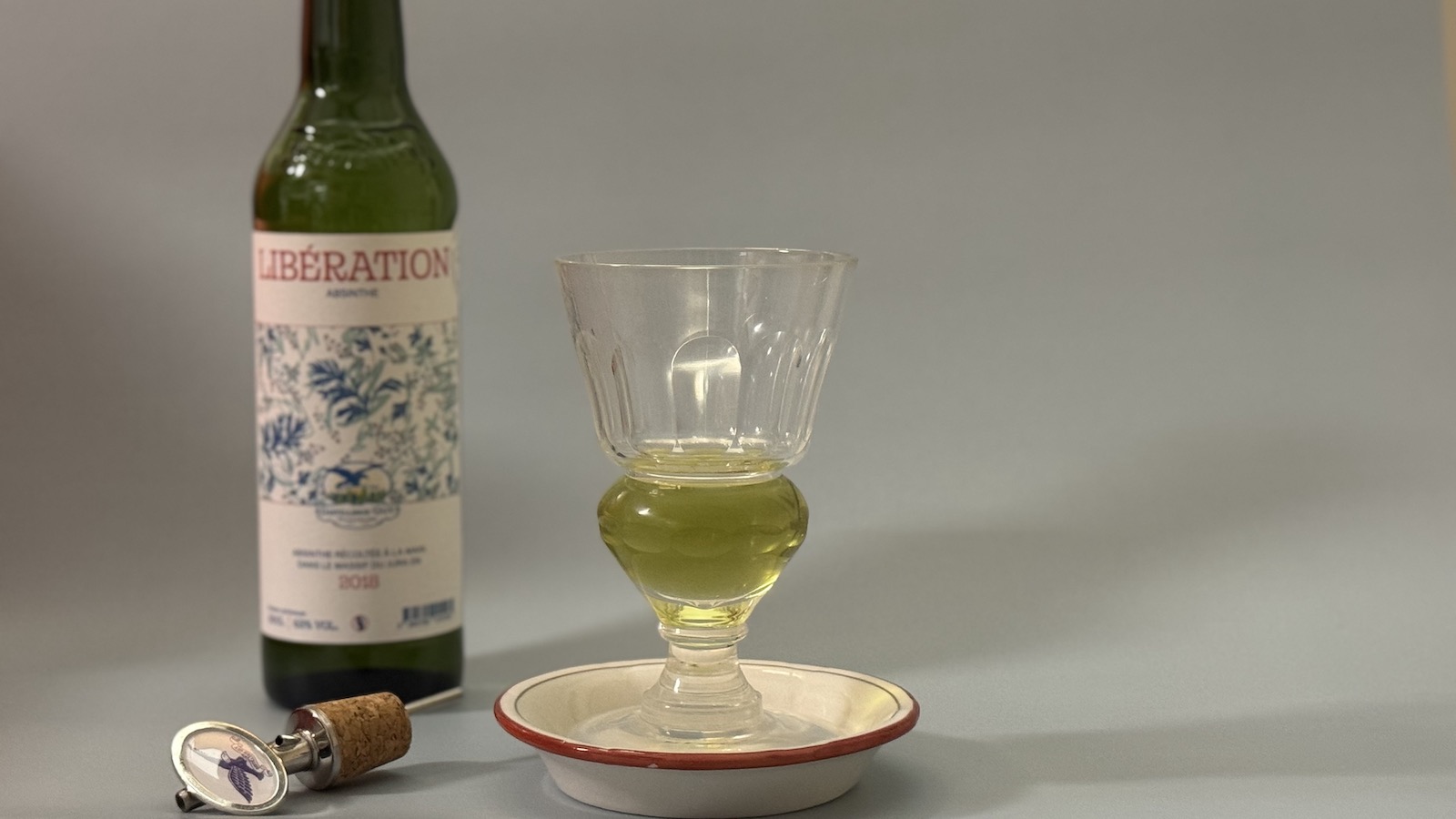
Welcome to the fifth article in my series where I dip into my collection of absinthe, sample and discuss a single bottle and its maker, and always veer off into tangents and assorted self-indulgery. Please enjoy, and if you catch any factual screw-ups in the article, yell at me in the comments and I’ll fix them asap and we can pretend it never happened.
Today we’ll discuss a wonderful expression by a long-running, legendary distiller from Pontarlier, France… the delightful Libération from Distillerie Guy.
Intro
My previous four Absinthe Profile articles all focused on absinthes that Sabrina and I picked up on our visits to Val-de-Travers, the French-speaking Swiss valley in the Jura Mountains, widely regarded as the historical birthplace of absinthe. On our most recent visit out there, we chose to make our home base across the border in Pontarlier, France, which is widely regarded as the historical capital of absinthe.
You might say that the Swiss invented absinthe in Val-de-Travers, and the French took it mainstream in Pontarlier.

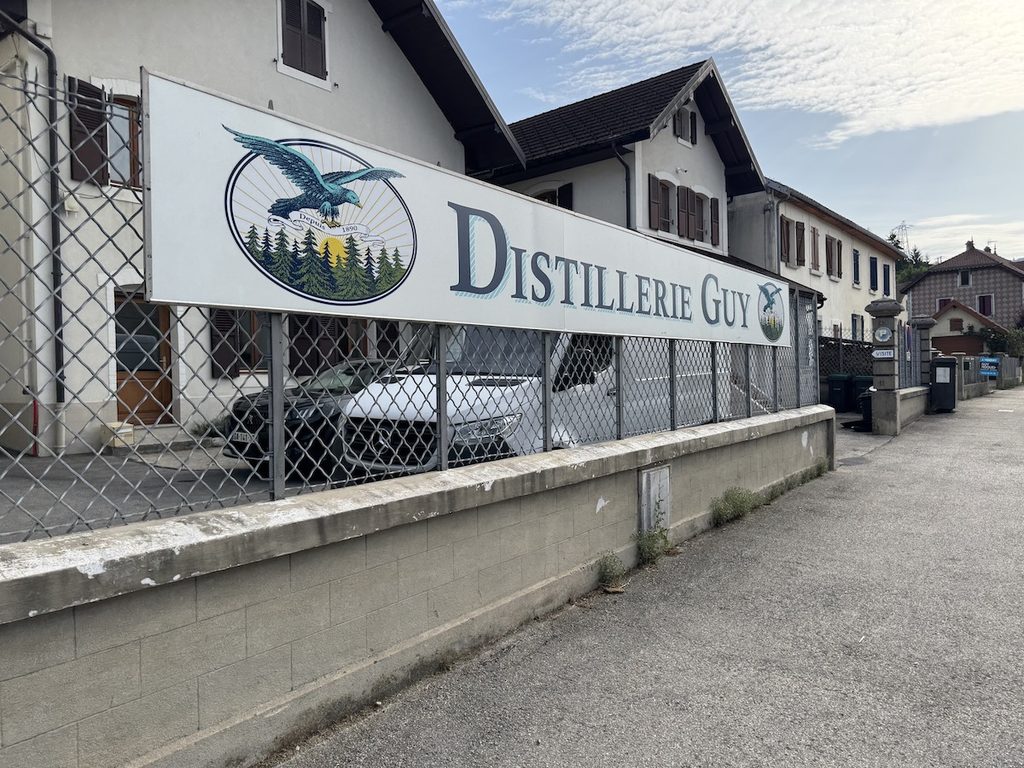
Pontarlier is a fairly quiet, comfortable town these days, at least from the perspective of Sab and I, who’ve spent our adult lives in a big US city that is neither quiet nor necessarily comfortable. Pontarlier did not appear to be heavily capitalizing on its absinthe past. Sure, there’s the Musée Municipal de Pontarlier (Municipal Museum of Pontalier) that has a section devoted to Pontarlier’s absinthe history, and there’s a couple of historically significant distillers, namely Distillerie Guy and Distillerie Les Fils d’Emile Pernot (which we’ll discuss in an upcoming profile), AND there are a couple of smaller, less tourist-centric distillers, but still, it felt more like Pontalier was simply proud of its history rather than trying to aggressively market it.
Once Sab and I started our walk to find Distillerie Guy, however, we did observe a number of signs around town navigating visitors to the distillery, confirming that this famed absinthe producer is indeed considered a critical city landmark, as well as a destination for wormwood-loving out-of-towners.
And Distillerie Guy was certainly a cool destination, with its gorgeous, massive vats of aging spirits, its tasting room hosted by friendly folk generous with their samples, and a killer collection of merch that could rival some of our larger U.S. breweries’ merch shops.
All in all, we found Pontalier to be a charming and reserved city, far more focused on day to day living than on trying to make a buck off tourists, of which there were not many (at least not obvious ones like us). But for absintheurs, it’s a vital part of history and it most certainly warrants an afternoon of wandering about, preferably after sipping on some delicious Libération in the Distillerie Guy tasting room like Sab and I did.
The Absinthe
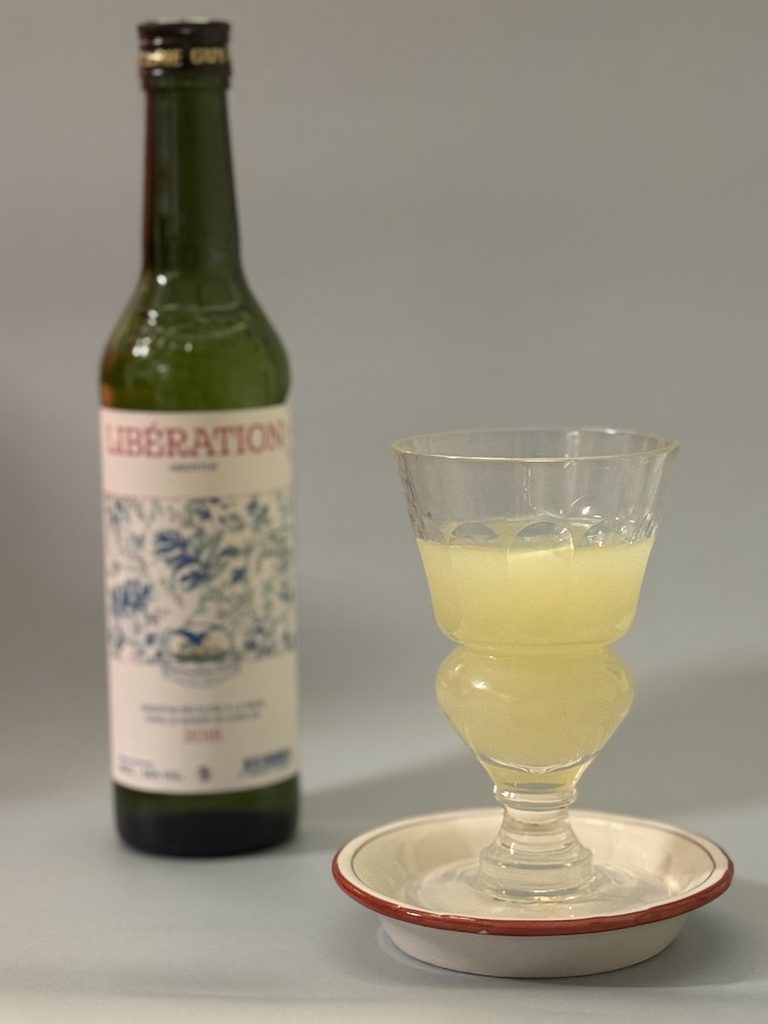
Libération is 63% ABV French verte (green) absinthe containing ingredients of grande absinthe (wormwood), anise, rosemary, lemon thyme, lemon verbena, and others. It comes from (I believe) a brandy base spirit, and it’s macerated and distilled in century-old copper stills.
As stated on their website, the ingredients bring forth strong citrus which contributes to its fresh, light, and accessible character. With its focus on the balance between the bitter wormwood, the sweet green anis, and the citrus, Libération captures the essence of traditional pre-prohibition French absinthes, while leaning on the rosemary and citrus additions to foster its own unique, modern character.
The website also calls out that Libération is made only with natural ingredients, without artificial color, flavor, or preservatives. One would not expect otherwise from an absinthe from this region, but in the wider world of absinthe, you can find plenty of imposters (“fauxsinthe”). So, good on Distillerie Guy for calling it out.
Libération was originally created for Absinthiades, the annual absinthe competition held right there in Pontalier, and it medalled on its debut. It went on to take home a bronze in 2024.
To honor the Bourbakis
The name “Libération” pays homage to its home city of Pontarlier and the French soldiers who play an important role in the city’s history, the Bourbakis. Who are the Bourbakis? Well, from what I learned, it goes back to a General Charles-Denis Bourbaki, who commanded a French army in the Franco-Prussian war that was attempting to relieve the besieged French town of Belfort, situated about 25 kilometers from the France/Swiss border.
Things went bad for the Bourbaki army, and after failing to break through the Prussian lines, they were forced to retreat towards Switzerland in the middle of a bitter, cold winter. The Swiss allowed them in, and upwards of 87,000 French soldiers were distributed amongst various Swiss communities, where they were allowed to live (but not perform any military operations) for the next six weeks. Following the preliminary France-German peace agreement, the soldiers were able to return back to their homeland, and France later reimbursed Switzerland for the costs of housing its soldiers.
I’m not sure if the name “Libération” is a reference to the soldiers returning home or to an entirely different aspect of the war, or if I’m not even in the right war (I’m neither a historian nor a journalist, mind you; just an affable drunk), but if I find out, I’ll let you know. Regardless, there’s your Bourbaki trivia for the day.
In summary, Libération is a modern take on traditional absinthe from an historical absinthe town by a distillery that was distilling all the way back during absinthe’s heyday a century ago, and has been perfecting the craft through multiple family generations. So, expectations should be high for this one. And it lives up to them.

The Maker
Distillerie Guy was established in Pontarlier back in 1890 by Armand Guy, who led the operation over the next quarter century, through the pre-prohibition golden age of absinthe.
In 1915, France banned absinthe (following Switzerland’s absinthe ban in 1910 and the U.S. in 1912), forcing French absinthe distillers to permanently shut their doors, or for those few that were more established and/or nimble, to pivot to some creative workarounds. Distillerie Guy, at that time under the leadership of Georges Guy, went the latter route, introducing an absinthe substitute called Pontarlier-Anis.

Pontarlier-Anis is, as the name suggests, an anis-based spirit modeled after their Pontarlier absinthe recipe, but using only green anise and no wormwood. Wormwood, as you may recall, was the ingredient that took the blame for the much-exaggerated horrors of absinthe’s past (I go into this a bit more in a previous Absinthe Profile).
Pontalier-Anis not only kept their lights on through the absinthe prohibition era, but indeed became Distillerie Guy’s cornerstone product.
Towards the tail end of the 1900s, Francois, the 4th generation of the Guy family, took the helm and underwent a multi-year effort to lobby for absinthe’s return to France. In 2001, despite it still technically being illegal, Francois took note of some government regulation changes around wormwood-based beverages introduced back in the 1980s, and began planting wormwood at the distillery and producing absinthe once again, legally. Worth noting that the absinthe recipe had to comply with strict rules around wormwood amounts, and he had to sell it as something like “wormwood-based spirit” rather than absinthe, but it was undoubtedly absinthe. After nearly a century-long ban, Francois Guy had succeeded in bringing it back.
In 2011, France repealed the original 1915 prohibition (allowing the name “absinthe” to be used again), and in 2015 made absinthe officially legal, thanks in large part to the early efforts from Francois and team.
In 2020, after nearly 130 years of family ownership across four generations of Guys, the distillery was acquired by Capelia, an independent investment company, and a couple investment partners. This would become the first time in its history that Distillerie Guy was not solely owned by the Guys.
In May 2026, Distillerie Guy acquired the one other remaining historical absinthe distillery in Pontarlier, Les Fils d’Emile Pernot, which had been going through a tough financial restructuring and was recently placed on judicial liquidation. Production of the Pernot spirits (including the popular Vieux Pontarlier absinthe brand) moved to the Distillerie Guy location, but the branding and recipes will remain as is, preserving the Pernot legacy and giving new life to this important link to Pontarlier’s past.

Sidebar: A Bit More About the Capital of Absinthe…
I like to cram an extra “Sidebar” section into these articles containing an absinthe-related topic that’s not specifically associated with the absinthe that I’ve been profiling. For this one, let’s just knock back a few more facts about Pontarlier…
Pontarlier is an historic French town located in the Jura mountains, just across the Swiss border from Val-de-Travers. The legendary distillery, Pernod, which started in the small Val-de-Travers city of Couvet in 1797, moved operations over to Pontarlier in 1805. From here, the sleepy French town quickly grew to become the epicenter of absinthe culture (both in producing it and consuming it), benefiting from its close proximity to Switzerland, its friendly climate for growing wormwood, and its welcoming and apparently anise-loving populace.

Btw, it’s worth quickly pointing out that Pernod and Pernot (the distillery I mentioned earlier in this post) are in fact two wholly different entities, and not just a typo on my part.
By the turn of the 20th century, Pontarlier had become the world’s leader in absinthe production by a long shot. At its height in the early 1900s, the city of 10,000 residents had 25 distilleries, 150 bars and cafes, and was producing 15 million litres of absinthe annually, with Pernod, by now an industry giant, responsible for almost half of that volume.
France, like many countries before it, officially banned absinthe in 1915, effectively killing the absinthe culture that was such an integral part of Pontarlier and neighboring French cities. The vast majority of French absinthe distillers died. Pernod shut down its Pontarlier absinthe operations. It would continue to produce non-absinthe spirits from other locations, though, while also producing smaller volumes of absinthe in Spain where it was still legal, and over the decades it would grow into the international spirits behemoth, Pernod Ricard. But here in Pontarlier, Pernod was gone, and so were the halcyon days of absinthe.
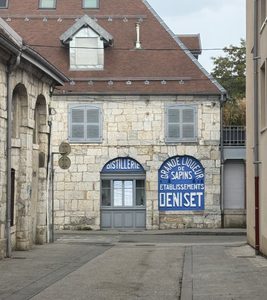
Even after Distillerie Guy resumed absinthe production in Pontarlier in 2001 (while not calling it absinthe since absinthe was still illegal), Pontarlier never returned to anywhere near the heights of absinthe culture that it experienced in the late 1800 and early 1900s.
But the spirit of absinthe’s heyday will always be part of the city, and Pontarlier’s important role in history is well regarded. In 2019, the European Union officially registered Absinthe du Pontarlier as a protected regional indication, specifying that in order for an absinthe to be considered a genuine Pontarlier absinthe, it must contain wormwood cultivated within a designated area in Pontarlier, maceration/distilling/bottling must occur in the designated area, plants must be harvested by hand and dried according to specific methods, distillation must be done in copper stills, and the finished spirit must contain at least 45% ABV. You might think of this designation as similar to the geographic protections afforded to champagne and cognac.
Sab and Bones say:
Drinking a 3:1 water-to-absinthe ratio with no sugar…
“Spicy! Not necessarily herbal spicy, but spicy spicy. For me, it presents a very bold flavor, one that hits all of my tongue at the same time. It comes off as rather strong at first, then mellows significantly in a way that I really enjoy. I’ve come to realize that some of the boldness/strength may simply be because Bones made it, and he makes everything strong. I’d probably serve it with a little more water. Nonetheless, a delicious, memorable absinthe.”

Sab
“Spicy, indeed. Right up front, spicy and bold, followed by a deep bitterness that lingers on the back of the tongue, buzzing. It’s very nice. It has a soft, creamy, marshmellowy mouthfeel, and a bright green color that louches into a yellowish white that’s pretty, while not as dense as some of the recent Swiss ones we’ve tried. Anis flavor is prominent up front but very pleasant, softened but not overpowered by the nice citrus notes. Complex but very accessible. A great absinthe.”

Bones
Sources and Suggested Reading
Distillerie Guy – Absinthe Libération product profile
Distillerie Guy – Our Heritage
French Ministry of Agriculture – The Guy Family Anise Distillery
Bourgogne-Franche-Comté Heritage Inventory – Pernod distillery
European Union geographic specs for ‘Absinthe de Pontarlier’
MaCommune.info A historic absinthe brand saved: Pernot taken over by the Guy distillery
<< Previous (La Valote Martin)
Next (Coming Soon) >>
Leave a Reply