
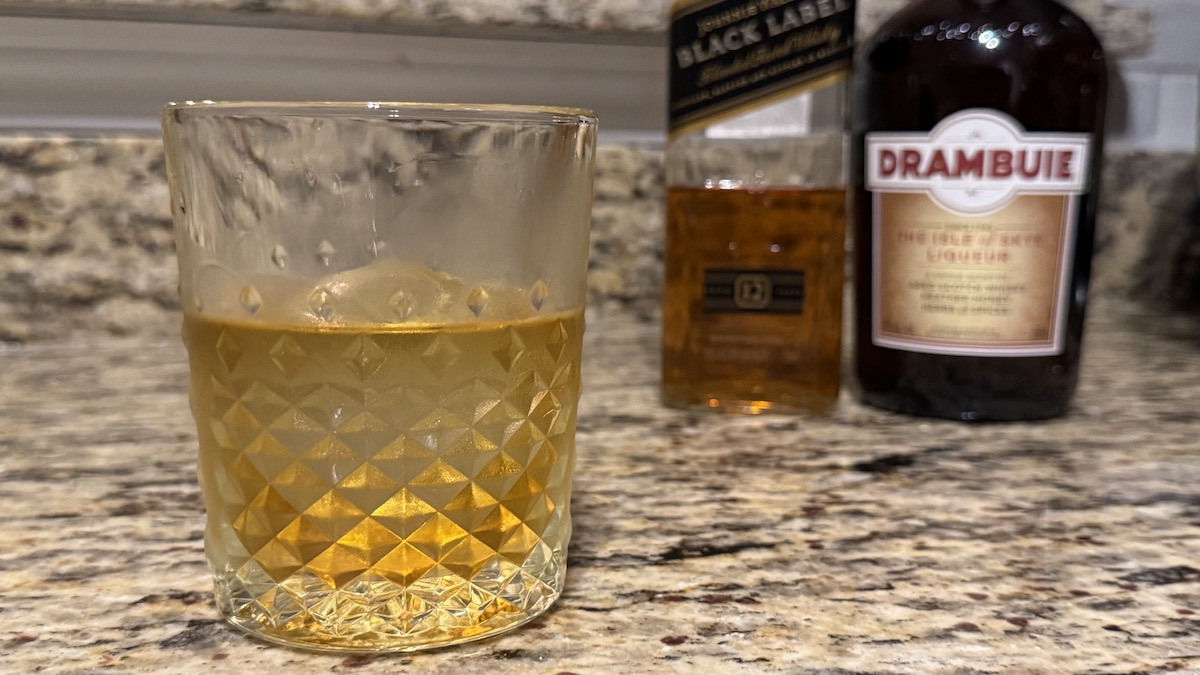
The twenty-third entry in the series where my wife Sabrina and I journey through the wide wonderful world of classic cocktails by crafting and drinking recipes together at our home bar. Today let’s sample that sweet and smoky Scotch sipper savored by Sinatra, the Rusty Nail.
Recipe:
- 2 oz Johnnie Walker Black Label Blended Scotch Whisky
- 1/2 oz Drambuie Scotch liqueur
Pour ingredients into a chilled rocks glass with a large ice cube. Stir gently to integrate and chill, but be careful not to dilute too much.
Intro:
The Rusty Nail is another drink that I always knew, but in name only. Pretty sure I never drank one nor did I spend any time thinking about one or what was in one. But in the deep recesses of my brain I’ve always assigned it a weird association with orange juice. I think I just now realized why, actually, and it’s stupid: I’m thinking of a Screwdriver (vodka and orange juice).
Yeah, Rusty Nail has the word “nail” in it, so I immediately connected it to a drink named after a tool that, well, has nothing to do with a nail. That sucks. And this is probably why Sabrina gets stressed when I decide to tackle a home improvement project.
Turns out that I like the Rusty Nail, though. It’s a drink for sitting back and sipping, slowly taking in the smooth blend of malt, smoke, honey sweet, and a light touch of herbaceousness. A glass of good Scotch softened up by a hit of sweet liqueur.
From my novice perspective, this is the drink you drink when you’re kind of in the mood for Scotch but also not entirely in the mood for Scotch.
This is also the drink you drink if you want to relive some old school party vibes, the way Frank Sinatra and his Rat Pack boys rolled back in the day. The same fellas credited with popularizing the Rusty Nail, by the way. You know the vibe I’m talking about, right? Leather chairs and couches, dark wood paneled walls, fireplaces, cigars, steaks. Basically what home furnishing stores think every guy wants for his “Man Cave.”
I abhor the term “Man Cave,” but my garage has been accused of being one many more times than I’d care to admit. It is certainly not decorated in Man Cave chic, though. It’s fair to say that my garage decor is far less “Sinatra’s Upscale Drinking Establishment” and far more “20 Year Old Stoner’s First Apartment.”

Booze Basics:
The Rusty Nail is a very simple drink to concoct, a product from the time period when people had moved away from the more elevated, artisanal cocktails (what would be resurrected decades later as “craft cocktails”) into more simple and often sweeter libations. The kind that you could make at home with just a bottle or two from your fancy mirrored bar cart without all that extra fanfare like cocktail shakers and strainers and mixing glasses. Nah, you just pour right into a glass full of ice cubes, give it a quick stir, and hand it over to your buddy in the open chested polyester shirt. This was the same era where we see the rise of other notable simple drinks like the Black and White Russian, Harvey Wallbanger, and Godfather.
A simple recipe ain’t a bad thing, though, when the minimal ingredients work well together. Which they do in a Rusty Nail. Scotch and Drambuie on ice, stirred. That’s it. Drambuie is a Scotch-based liqueur, so, simply put, a Rusty Nail is Scotch with sweetened Scotch on top.
A classic Rusty Nail is 1:1, meaning equal parts Scotch and Drambuie. But damn, that would make a really sweet drink. Many modern recipes go with 2 parts Scotch to 1 part Drambuie, but that’s still too much Drambuie sweetness for many of us. David Wondrich, in his Esquire article, recommends that you start with 4:1 and just adjust according to your tastes, and he’s the GOAT so I took his word for it. I liked 4:1.
Traditional recipes call for “layering” the Drambuie on top of the Scotch base. Wondrich says don’t bother, so I didn’t bother. If we’re going simple, let’s go simple, right?
Don’t Look Now:
I did consider going even lighter on the Drambuie, dialing it down to 1/4 oz, to dry the drink out even more than the delightful 4:1 ratio.
Why? Because then it’s called a “Donald Sutherland.” Why? Because what else would you call it?
“Donald Sutherland” is not an “official” name or recipe. It’s more like bartender code for a really dry Rusty Nail. Apparently it doesn’t even have any historical connection to the Don. There’s no record of him inventing it, endorsing it, or hell, even ordering it, from what I gather. At some point, it just became the name.
Just like my Honda Civic from back in the early 2000s. I named it Donald Sutherland as well. For real. Why? Because what else would I call it?
So yeah, I’ve not had a “Donald Sutherland” cocktail yet. But I don’t care, it’s my favorite drink now.


On Drambuie:
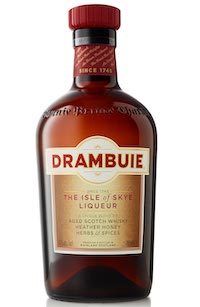
I think we all generally know what Scotch is, but many of us could probably benefit from a brief Drambuie primer, so let’s do that.
Drambuie (pronounced “Dram booey”) is a 40% ABV Scotch-based liqueur infused with heather honey, herbs and spices. The exact recipe is a secret, though, and only three people know it.
The name Drambuie comes from the Scots Gaelic “An Dram Buidheach,” which loosely means, “the drink that satisfies.”
According to lore, the origination of Drambuie takes place in 18th century Scotland during the Jacobite Rising of 1745. Charles Edward Stuart (“Bonne Prince Charlie”) was on the run after the Battle of Culloden, and was given sanctuary by John McKinnon of the Isle of Skye. As a thank you, the prince gifted the McKinnon clan a secret recipe for a medicinal whisky elixir, which eventually became Drambuie. This may not be entirely historically accurate, but makes for some good marketing material.
Drambuie wasn’t commercially produced until the late 19th/early 20th century, and its reputation slowly built from there.
In the 50s through the 70s, the distiller really leaned into marketing, hopping on all the Sinatra/steakhouse masculine imagery associated with Scotch around that time. Then when the Rusty Nail became a household name, Drambuie tied their marketing efforts closely to the drink.
Prior to the Rusty Nail, Drambuie was looked at as strictly an after-dinner cordial, but it was now considered a critical component of a highly fashionable cocktail ordered by highly classy dudes in cool suits.
More info – Wikipedia | Official Website
Origin Story:
Unlike most of the cocktails we’ve discussed so far, no specific individual is credited with the invention of the Rusty Nail drink, or even with the Rusty Nail name. People had been mixing Scotch and Drambuie since at least the 1930s, but we don’t see the name “Rusty Nail” start to show up until the late 50s/early 60s.
Liquor.com notes that some believe the drink was actually invented at the 1937 British Industries Fair trade show, and appears in the 1967 edition of Old Mister Boston’s Official Bartenders Guide. A similar drink called “Little Club #1” shows up in Ted Saucier’s 1951 Bottoms Up book.
Some claim that the Rusty Nail is named after the rusty nails on the crates of Drambuie, and others claim that it’s because bartenders stirred the drink with rusty nails (insanelygoodrecipes.com), but I’m calling bullshite on both of these. This sounds a lot like all the dark theories around the origin of the band name “Nine Inch Nails”, only for Trent Reznor to come out and say that the name simply looked cool in print and that NIN makes for a badass-looking abbreviation. Which it does. (americansongwriter.com).
The name did get a lot of publicity from the 21 Club in late 50s/early 60s New York, which was amplified by frequent club visitors, Frank Sinatra and his Rat Pack homies. The fellas may or may not have even been big Nail drinkers, but the crooner bros lifestyle they embodied (“Man Cave chic”) became attached to the drink.
Once the Rusty Nail started showing up in print in the 60s, Drambuie made it a major part of their marketing, thus pushing both the drink and the liqueur messaging to even greater reach.
As mentioned above, the Rusty Nail grew even more popular in the 60s and 70s, as drinking culture moved from cocktail craftsmanship to more simple builds. Then when we moved into the late 70s and early 80s, trends changed again, introducing the “lite” phase of drinking (lite beers, simple vodka mixes, etc) and the Rusty Nail mostly faded into the background.
We see a minor revival of the Rusty Nail, along with so many other cocktails that had been neglected over the years, with the cocktail revolution of the early 2000s. The Rusty Nail doesn’t seem to have received as much attention as some of the other classics, though. But now that we know there’s a version named “Donald Sutherland”, we must change this. And we mustn’t stop until we see a Donald Sutherland at the top of every drink menu in this grand country of ours.
Oh, yes, and then we need to come up with a cocktail for his son, Kiefer. Maybe it’s Drambuie and Gentleman Jack. For Jack Bauer, you know? Admittedly, I didn’t spend too much time noodling on that one…
Recipe Rationale:
Johnnie Walker Black Label Blended Scotch Whisky: Since Scotch is the primary ingredient, you’re going to want to go with something mid to high quality, and blended Scotch is your best bet for this drink. I already had a bottle of Black Label in my liquor cabinet, so I went with that, and it worked quite nicely.
Drambuie: This stuff is kinda pricey, and there’s not a lot of cocktail recipes that call for it. So, you’re buying it pretty much for Rusty Nails. Hopefully you like them.
Verdict:
“Hi. Bones here, writing on behalf of Sab… Sab is out of town and didn’t get to try this one. But I can confidently say that she wouldn’t like it. I think she’d say it’s far too boozy. I don’t even think she’d like the Donald Sutherland. I’m pretty sure she doesn’t know or care who Donald Sutherland is. And I guarantee she hasn’t seen “Don’t Look Back” starring Donald Sutherland, and would not be happy with me if I played it for her. That’s a creepy-ass movie.”

Sab
“I’m a fan. Strong sweet honey taste up front followed by a nice smokey bite of Scotch in the back. Fairly thick mouthfeel and a pleasant alcohol burn. A little sweeter than I’d normally want in a drink, but it works here. Plus, from here on out I’ll be drinking the drier Donald Sutherlands anyway, because Donald Sutherland Donald Sutherland Donald Sutherland. I think I’ll put this on my rotation up there with an Old Fashioned, for when I want a good slug of whiskey but don’t want to fully commit to straight whiskey for some reason.”

Leave a Reply