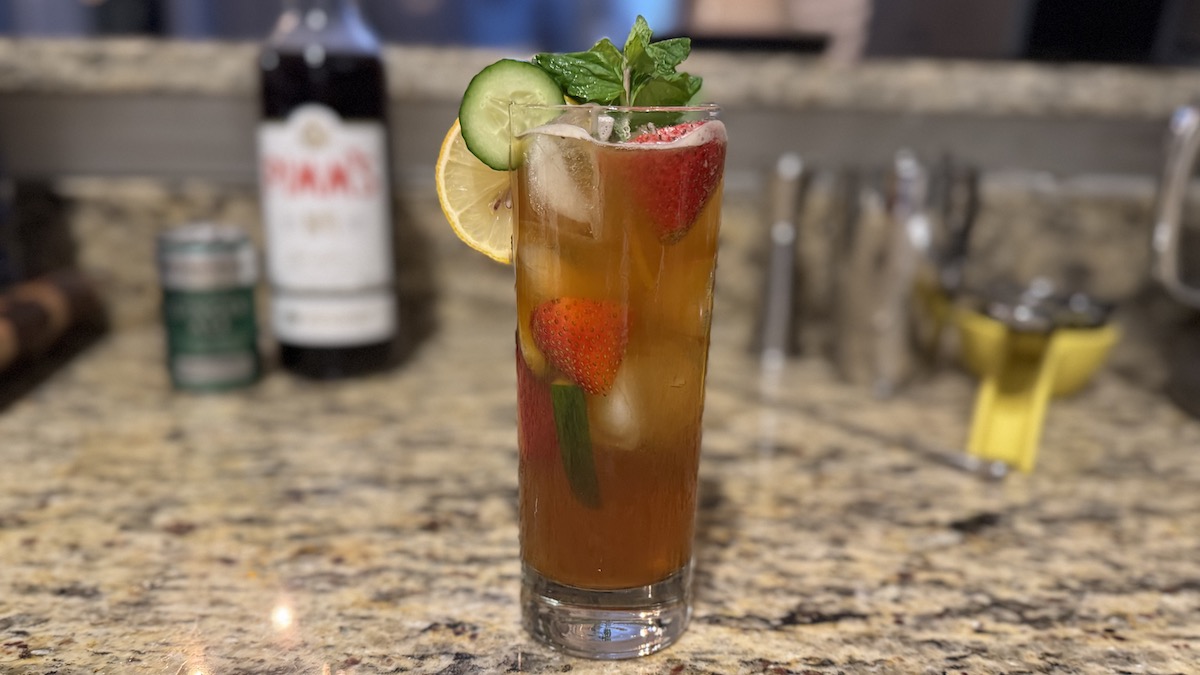
The sixteenth entry in the series where my wife Sabrina and I journey through the wide wonderful world of classic cocktails by crafting and drinking recipes together at our home bar. Today let’s partake in this pleasant patio crusher from across the pond, the Pimm’s Cup.
Recipe:
- 2 oz Pimm’s No. 1
- 3/4 oz. Fresh lemon juice
- 1/2 oz. Simple syrup (1:1)
- 3-4 oz. Fever Tree ginger ale
- Garnish: Cucumber slice
- Garnish: Mint sprig
- Garnish: Strawberry slice
- Optional Garnish: Orange or lemon wheel
Add the Pimm’s, lemon juice, and simple syrup to a shaker full of ice and give it a short shake (approx. 8-10 seconds). Go easy on the shake; you just want to integrate the ingredients, not dilute them with melted ice. Strain into a tall glass full of ice. Top with the ginger ale. Give it a quick stir but go easy on that too, since you don’t want to stir out the carbonation. Then go nuts with the garnishes. Garnish it with no abandon, like you’d do with a Bloody Mary. The cucumber is critical, though. And don’t forget to give the mint a good smack to release its minty goodness before tossing it in.
Intro:
Pimm’s Cup was one of the cocktails that I was excited about when I started this little “Making Classic Cocktails at Home” project. I’d seen it on numerous drink menus but had no idea what it is nor would I likely ever think to order one, so it was doomed to just eternally hang around my periphery, unappreciated and misunderstood, if it hadn’t found its way on to my Must Make List. Glad it did.
What it is, is a delicious, simple drink, designed for knocking back multiple under the hot sun, compliments of our buds over in England. In fact, you might even consider that my recipe above is far more high falutin than what folks originally fashioned. The traditional English version is simply Pimm’s No.1, British lemonade, and garnish, over ice. It’s meant to be something you can throw together quickly and easily, with a low ABV for session drinking that won’t lead to those unfortunate altercations often introduced by afternoon indulgence.
And it just occurred to me that this is not the first time I’ve written about non-US originating cocktails from a purely American perspective. My apologies to my non-U.S. homies. I don’t mean to be America-centric. In fact, you might even consider it to be false modesty where I pretend like I’m just a lil’ blog in the States whereas I’m truly secretly expecting my blog to achieve full global domination in the next seven or eight days. Well, give or take a decade or nine.
Booze Basics:
As I said, I had no previous knowledge of the Pimm’s Cup so I have no personal history of it, thus I can’t bore you with self-indulgent anecdotery of how I irresponsibly over-imbibed it in my younger days. So let’s just get to the booze talk, shall we? Starting with what the hell Pimm’s is…
Pimm’s, or more specifically, Pimm’s No. 1, is a spiced liqueur made by infusing gin with a secret batch of herbs, citrus, and warm spices that give it notes of bitter orange, clove and cardamom, and a mild sweetness. It’s also low alcohol – 25% ABV or so – which is why I’ve already mentioned more than once that the namesake cocktail is built for drinking more than one. And I’ll say it again more than once too.
I explained above that the original version just uses British lemonade, Pimm’s and garnish. So why did I go and get all fancy on the version I made? Well, first of all, British lemonade is a fizzy lemony drink, different from our sugary non-carbonated lemonade here in the U.S. And I don’t have any of that.
A Pimm’s Cup stateside is sometimes made with our American style of lemonade, giving you a non-carbonated version of a lemony Pimm’s Cup. Other times it’s made with ginger ale, giving you a carbonated non-lemony version of a Pimm’s Cup. Or it’s made with Sprite or 7 Up, giving you carbonated “lymon” version (remember “lymon”?). I chose to go with a “hybrid” version, using fresh lemon juice and simple sugar to build my own fresh lemonade, and ginger ale to carbonate it and give it some extra spice. It tastes great this way and I highly recommend it, but of course, I know no other way. It was my first Pimm’s Cup. Won’t be my last, though. Shit’s delicious.
Let’s talk about all that garnish in my recipe, though. That’s not me being fancy. Garnish is key. The more the better. I’ve seen it described as making an “English Garden.” From what I can tell, it’s a lot like a Bloody Mary in that you can get creative with what you throw in there, but the cucumber, mint and strawberry are indeed critical. And for good reason, as they give it that fresh, afternoon-y nose and flavor that’ll make you wanna slam it and order another (there I go again with that).
Speaking of glassware and abrupt segues, what’s the appropriate glassware for a Pimm’s Cup? Doesn’t really matter. Something tall. Consider this: Pimm’s Cup is the defacto drink of the Wimbledon tournament, and I would presume they’re not drinking out of fancy cocktail vessels up there in the stands. I think the point is more about enjoyment. I made mine in a Collins glass and that worked out well, if not being just a little tough to get a good spin of the bar spoon in that slender glass with all the ice and garnish floating around in there. You can’t go wrong with a regular old pint glass, even if it doesn’t look as cool.
Morning Drinks vs. Day Drinks
While doing my research on the Pimm’s Cup, I kept finding myself comparing it to a Bloody Mary, perhaps unfairly, due to there being such a strong focus on the garnish. Admittedly, there’s not a lot of other similarities, other than maybe that they both consist of a spirit and a non-alcoholic “lengthener” (Bloody Mary mix vs. lemonade/ginger ale). The garnish isn’t necessarily similar between the two either, but I do see big similarities in the spirit of the garnish. Both cocktails come with basically a fruit or veggie salad crammed into the glass, a healthy booze-soaked vitamin-rich snack that, after downing the drink, you spend the next 20 minutes trying to retrieve with your straw. Sort of a barfly’s version of an arcade claw machine.
This line of thought then led me to internally debate morning cocktails vs daytime cocktails. Of course, a Bloody Mary is considered a morning drink. As is a Mimosa. You can expect to be judged if you order most drinks before noon, but you’re a breakfast hero when you order a Bloody or a Mimosa with your eggs. Not entirely sure why we landed on these two being our main morning tipples, but certainly all the vegetables in the Bloody Mary contributed to it making the cut.
So wouldn’t it make sense to put a Pimm’s Cup in the morning category too, perhaps as the mid-range beverage in between a Bloody and a Mimosa? Its overabundance of garnish even leans more on the fruit side, arguably more breakfast-friendly than the olives and pickles and whatnot packed into a Bloody. A Pimm’s Cup is also low alcohol, which some would say is a positive for a morning toot. And of course, both the Bloody and the Pimm’s are heavily focused around occasion and vibe, and with an emphasis on the presentation of the drink, all contributing to a good late morning hungover brunch hang.
But nope, the Powers that Be deemed Pimm’s Cup an afternoon drink, not a morning drink. Aligning it more with, maybe, an Americano, a low alcohol cocktail consisting of Campari, sweet vermouth and club soda that is also considered an afternoon drink. Or maybe an Aperol Spritz. In fact, you might consider a Pimm’s to be the English cousin to these Italian day drinks. All are refreshing, taste great under the sun, and you can knock back a couple without destroying your day. But you must drink them during the day, not the morning. If you drink them with pancakes, you are a drunkard.
I don’t know, man. I don’t think we’re any closer to unlocking the complex labyrinth of logic around what and why we can drink when. And frankly, it’s not even relevant to me. Unless I’m on vacation, I almost never participate in morning or day drinks. I’m old. It all just leads to a nap and then waking up in the evening, groggy and pissed off because I was supposed to mow the lawn that afternoon.
Origin Story
Pimm’s No. 1 liqueur was created in the 1840s by a London oyster bar owner named James Pimm, originally as a digestive to get you through the aftermath of a big oyster dinner. He created a series of liqueurs, or “cups” as he called them, forgoing actual names and just assigning each of them a number. No.1, the gin-based liqueur is really the only one that’s still widely available, but back in the day there were quite a few, such as No. 2 (scotch-based), No. 3 (brandy-based), No. 4 (rum-based), No. 5 (rye-based), etc.
Simply Recipes reports that the original Pimm’s Cup cocktail didn’t make it into a recipe book until 1946’s The Stork Club Bar Book, and then shortly afterwards it found its way over to the U.S. where it was adopted and popularized by the Napoleon House in New Orleans. Napoleon House’s version has now become a staple drink of New Orleans.
Back in England, it became the quintessential drink for afternoon sporting events, and is closely associated with Wimbledon, much like our Mint Julep is with the Kentucky Derby (and here I go again, constantly bringing it back to the U.S.). An official Pimm’s bar opened at Wimbledon in 1971, and per Town and Country magazine, over 300k Pimm’s Cups are served annually at the legendary tennis tournament.
Recipe Rationale:
Pimm’s No. 1: If you’re making a Pimm’s Cup cocktail, your only option for the booze is Pimm’s. And a Pimm’s Cup cocktail may likely be the only cocktail you’ll make with your bottle. But it’s certainly worth having one in your liquor cabinet and increasing your summer cocktail options.
Fresh Lemon Juice: As mentioned above, there are different ways of making a Pimm’s Cup, but if you want to go with the traditional English version, you’ll want to find yourself some sparkling lemonade, ideally a British kind. If you’re not a stickler for tradition, then I recommend the recipe I posted here. Just remember to squeeze your lemons instead of buying the juice. Fresh is key.
Simple Syrup: Easy to find a bottle at the store or, really, just as easy to make your own. I included a simple recipe for 1:1 simple syrup in my Whiskey Sour post.
Fever Tree ginger ale: I always go with Fever Tree for mixers since they’re high quality and available at your standard grocery store. But whatever ginger ale you have on hand should be just fine.
Verdict:
“Great flavor profile. Delightful, like the air after a thunder storm. I really like the pairing of cucumber and mint.”

Sab
“Super refreshing, light, and easy drinking. I also thought the cucumber and mint really stood out, and they played so nicely with the spice from the Pimm’s. The ginger ale mellowed out the lemon juice, leaving enough that you can taste it without being blasted by tartness, which was nice for a lemon wimp like me. All the fruit and cucumber, along with the overall lightness of the drink, made for a fantastically fresh tasting cocktail. It just screams ‘sunny day.’ Although, I still stand firm in my argument that, philosophically, this can be a breakfast drink. Not to mention, the spicy Pimm’s can serve as a decent breath freshener if you didn’t get around to brushing your teeth before brunch. If not Pimm’s, you’d have to ask the server for a Fernet-Branca to use as mouthwash, which would be inexcusable because it’s not a morning drink. Sorry, I didn’t make the rules.”

Bones
Next (Coming Soon) >>
Leave a Reply