
The fifteenth entry in the series where my wife Sabrina and I journey through the wide wonderful world of classic cocktails by crafting and drinking recipes together at our home bar. Today let’s sip on our first cognac-based cocktail in the collection, the simple, splendid Sidecar.
Recipe:
- 2 oz Remy Martin VSOP Cognac
- 3/4 oz Cointreau liqueur
- 3/4 oz Fresh lemon juice
- Garnish: Lemon twist
Add all ingredients to a shaker with ice. Shake until cold (approx. 10 – 15 seconds). Strain into a chilled couple glass. Express a lemon twist over it, rub it along the rim, and drop it in.
Intro:
I was excited to make this cocktail for the first time because its base spirit is cognac and I know jack shit about cognac. My only experience with cognac that I can recall is that I served a lot of Hennessey & Cokes and Courvoisier & Cokes at the St. John island bar where I worked during a summer in the early 90s. Mixing cognac and cola perhaps isn’t the best way to appreciate all the nuance of this fine spirit, but we weren’t exactly claiming to be pioneers of pouring pomposity at the bar back then and, in fairness, our clientele wasn’t claiming to be there for anything but a good buzz and a cheap happy hour. Not to mention, I was so green behind the stick that I probably thought those bottles were rum brands and I was just serving up a taste of the islands.
So it’s been fun for me to reconnect with a spirit that I mistreated back in those days of naive neophytery. We’ll dig a little deeper into cognac in a minute, but before we do, let’s discuss the drink itself, shall we?
Booze Basics
A Sidecar, like many of the others we’ve explored so far, falls under the sour line of cocktails, constructed in the familiar pattern of spirit, citrus, and sweetener. In the most basic sour, the sweetener is usually sugar or simple syrup. In the case of the Sidecar, the sweetener is an orange liqueur. If this sounds familiar, it’s because we’ve discussed this same spirit/citrus/liqueur pattern in my past articles on the Margarita and Cosmopolitan.
For a quick refresher, a Margarita is simply a Sidecar with the cognac swapped for tequila and the lemon juice swapped for lime. A Cosmo is a Sidecar with the cognac swapped for vodka and the lemon juice swapped for lime (and with some extra cranberry).
The Cocktail Codex book classifies the Sidecar as one of their 6 core cocktail “templates” under which all other existing cocktails are categorized. Margarita and Cosmo both live in the Sidecar family. But a Daquiri, another classic sour which uses a simple syrup sweetener, is a separate template, differentiated because it’s composed of just a single spirit rather than a base spirit and a liqueur.
I’ve brought up the sour pattern and the Cocktail Codex classifications in numerous past posts because I like to emphasize how cocktails aren’t each their own unique creature born in a vacuum but rather a series of riffs off one another. Plus, as an old software guy, I’m kind of a geek about design patterns.
Apparently my own personal pattern is to fill this post with information already covered in previous posts, so I’ll call your attention to the fact, once again, that this is a citrus drink, and thus needs to be shaken, not stirred, to properly integrate the ingredients and to give the drink its frothy body that we associate with sours.
Ultimately, the ingredients of a Sidecar together are going to give us a bright, refreshing citrus drink, compliments of the lemon juice and the orange liqueur, but also warmed and softened with a mild touch of oakiness from the cognac. Both the cognac and the orange liqueur will introduce a sweetness, amplifying each other and softening the tartness intensity from the lemon. So while a Margarita and Daiquiri are often looked at as sunny day drinks, a Sidecar can be a bit more weather agnostic.
On Cognac:
So we’ve beat the sour horse as much as we can, and we’ve already discussed orange liqueur in the past Margarita post, which leaves us to kick around cognac for a bit.
First of all, what is cognac?
Well, cognac is a brandy. And a brandy is a wide range of spirits that are distilled from fermented fruit juice. Commonly that fruit juice is wine (ie fermented grape juice) but there are also apple brandies, pear brandies, etc.
A cognac is a grape-based brandy with some very specific qualifications:
- Must be made in the Cognac region of France
- Most primarily use Ugni Blanc grapes
- Must be double distilled in a copper pot still and aged in french oak barrels
- Must follow strict rules on aging
You might think of brandy along similar lines as whiskey, since the production of both spirits is fairly similar except for distilling fermented fruit for the brandy instead of fermented grain. And just like a bourbon is a type of whiskey with specific rules wrapped around it, a cognac is a brandy with specific rules wrapped around it.
One of the defined rules for cognac is around how it is aged, and if you’ve seen a bottle of cognac, you’ve seen those unintuitive abbreviations on the bottle to represent the age range:
- VS (“Very Special”) – Aged for a minimum of 2 years in a barrel. This will be a bright, fruit-forward cognac with a light oak influence. Like most youthful spirits, it’s going to be sharper and have more punch. Great for mixing in cocktails, but not so great for sipping neat.
- VSOP (“Very Superior Old Pale”) – Aged for a minimum of 4 years in a barrel, which will give it more oakiness and a softer texture than a VS. You’ll start to pull more dried fruit and spice flavor out of if it as well. This is a good bang for your buck as it works in cocktails and can also be sipped neat.
- XO (“Extra Old”) – Aged for a minimum of 10 years in a barrel, giving it flavors of oak, tobacco, chocolate, and rich dried fruit along with a nice deep finish. For sipping only. These are not cheap, and you’re wasting money if you mix them in a cocktail.
Worth noting that cognacs are almost always a blend of different batches, rather than bottled all from a single barrel. The age on the bottle refers to the age of the youngest batch in the blend. So, if a cognac contains both a 5 year and a 2 year batch, it’s classified as a VS (barreled for 2 or more years) rather than a VSOP (barreled for 4 or more years).
Origin Story:
As with all the classic cocktails, the origin of the Sidecar is disputed, but most folks trace it back to World War I, where it was created at either Harry’s New York Bar in Paris or The Ritz London in London for an Army captain who was known for riding around in a motorcycle sidecar.
Liquor.com offers up another potential origin, at least for the origin of the name. As they point out, a “Sidecar” is, also, the name of that last splash of liquid that’s left over in the shaker after you’ve strained the drink into a glass, and served next to the finished cocktail in a shot glass. “Sidecar” is a perfect name for this concept, but I’m not sure how that concept would end up attaching to this one particular drink.
Personally I think I’m gonna stick with the story about the captain in the motorcycle sidecar, because motorcycle sidecars rule. This will surprise no one who knows me, but if I were given the choice of driving a motorcycle, or squeezing into the little sidecar attached to it, my ass is going into that sidecar every time. And you better believe I’d slap on a pair of those sweet goggles that apparently only sidecar riders are allowed to wear:
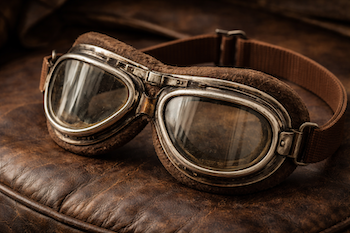
Also, the sidekick who wears sidecar googles is the 1910s version of the 1950s sidekick who wears 3-D goggles:

According to Cocktail Codex, the Sidecar is likely a variation of an earlier drink, the Brandy Crusta, which first appeared in Jerry Thomas’s 1862 Bar-Tender’s Guide.
Apparently in very early recipe prints, the Sidecar was equal parts cognac, orange liqueur and lemon juice, but then later it evolved into 2 parts cognac to 1 part orange liqueur and 1 part lemon. For my recipe, I scaled back the lemon and liqueur even more and it was still kind of a lemon bomb. For me, anyway. But I’m a lime guy.

Recipe Rationale:
Remy Martin VSOP Cognac: As mentioned above, I’m new to the world of cognac and wanted a bottle that would work well in cocktails or could be sipped neat. I found this one to be quite delicious, and it turns out that I really enjoy sipping on a cognac. A couple other ones that were recommended were Pierre Ferrand 1840 and Hennessy VS. But any decent VS or VSOP should work fine in a Sidecar, especially if you’re buying it solely for mixing in drinks.
Cointreau: Many of the recipes that I reviewed listed Cointreau specifically, rather than just calling for any orange liqueur, since Cointreau brings such a nice bright, clean, dry flavor along with it.
Lemon Juice: Always freshly squeeze your citrus, especially in drinks like this where the lemon juice is so prominent. Not to mention, you’re going to need the peel for the lemon twist garnish anyway.
Worth noting that traditional recipes also give the Sidecar a sugar rim, but it’s not as common a practice as it used to be. I chose to forgo it. I’m sure it goes very nicely with the lemon juice but I didn’t need the extra hassle or the calories.
Verdict:
“Delightful! Gives off some very nice warm weather vibes! I could drink 10 of these!”

Sab
“Very refreshing. Even with the tartness mellowed out by the cognac, it was still very lemon-forward. It was close to too lemony for me, honestly, but when I tried dialing the lemon juice down to 1/2 oz in the next drink, it lost a lot of its punch. So I think 3/4 oz is the right amount, but just barely. I certainly feel that original recipes with 2-1-1 would be far too lemony. But also, I’m a lemon wimp. I would have liked for the cognac to show up just a little more, but it did add a welcome noticeable warm backbone. All in all, I quite liked it. Probably my favorite lemon juice-based sour cocktail so far and I’ll surely make more of them, but I’ll probably make some minor recipe tweaks until I’ve got it fully calibrated to my tastes.”

Bones
Being that a Sidecar is a sour with a base spirit made from grapes, seems like a good excuse for me to cleverly insert this beloved ole classic from The Descendents, “Sour Grapes”:


Leave a Reply