

The twenty-eighth entry in the series where my wife Sabrina and I journey through the wide wonderful world of classic cocktails by crafting and drinking recipes together at our home bar. Today let’s take an expedition into the exciting world of tiki and explore this exemplar of exotica, the Mai Tai.
Recipe:
- 2 oz Denizen Merchant’s Reserve rum
- 3/4 oz Fresh lime juice
- 1/2 oz Pierre Ferrand dry curaçao
- 1/2 oz Fee Brothers orgeat syrup
- 1/4 oz Simple syrup (1:1)
- Garnish: Spent lime shell and mint sprig
Add all ingredients to a shaker full of crushed ice and a couple cubes and shake hard until cold. Pour it all into a double rocks glass or a cool tiki mug. Top with more crushed ice. Garnish with a mint bouquet and a spent lime shell.
Note that this recipe is a lesser variation of the Mai Tai recipe from Martin Cove’s seminal tome on tiki, Smuggler’s Cove. For the original, and better, recipe, get yourself a copy of that wonderful book.
Intro:
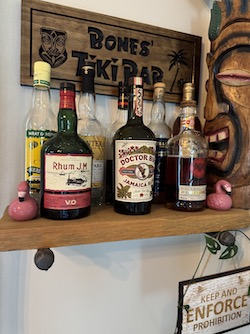
At some point during the Covid lockdown, back when I was still focusing my alcohol nerdery solely on craft beer and homebrew, I suddenly, and unexpectedly, became super pumped on tiki culture. I bought a copy of Smuggler’s Cove, a citrus squeezer, a muddler, a Lewis bag and mallet, a shit ton of rum, and started madly mixing a multitude of tiki drinks for Sabrina and me. I later bought an electric milkshake maker, as advised in Smugglers Cove, for flash blending drinks like the Junglebird, and Sab then expanded upon my new obsession by gifting me Bones-branded tiki decor, some tiki glasses, and more rum, and then I bought Minimalist Tiki by Matt Pietrek and Carrie Smith to learn new variations on all the drinks I’d just started making. I was listening to tiki podcasts and playlists of exotica tunes, wearing flowered shirts, thinking deep thoughts on crushed ice…
Much like the tiki bar had offered an escape from a challenging world during tiki’s birth in the 30s, tiki had become my escape from the doldrums of Covid solitude. Come Friday evening, it was time to trade in the depressing Zoom work calls for some joyous Zombies and Saturns!
It was a wonderful discovery and a great new hobby, but…
But much like a lot of people during Covid, I also started to focus a lot more on health and wellness, and, well, it turns out that a big ole’ cup of fruit juice, sugar, syrup and rum doesn’t abide so well with calorie counting. And so I had to cool my tiki obsession a bit, dialing it down to a more maintainable mild tiki stoke. Less Navy Grogs, more gin and sodas. You know the drill.
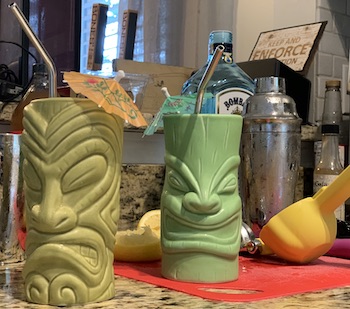
Nonetheless, I’m glad I had my brief flash of tiki overindulgence, as it introduced me to a wonderfully bizarre, esoteric, passionate drinking culture and a lifelong love for big ceramic Polynesian-inspired, excessively garnished, mugs full of exotic awesome.
And whenever Sab and I travel these days, we keep room in the itinerary for any spot that can serve an authentic, quality Mai Tai, the consummate tiki cocktail.
Booze Basics:
The Mai Tai is the epitome of Tiki. A beautifully balanced rum sour with orange and almond notes. Well, when it’s done right, that is. Such a legendary cocktail with such a mythological past is undoubtedly going to encourage many a knockoff, and you don’t have to look hard to find gross misinterpretations of the Mai Tai out in the wild, polluted with pineapple juice, orange juice, grenadine, you name it. At its true core, though, a Mai Tai is just a mix of quality aged rum(s), curacao, lime juice, orgeat syrup, and simple syrup. A delicious, simple, and near perfect rum showcase.
Let’s break down those components:
Rum, of course, is the lead actor in a Mai Tai, contributing notes of caramel, vanilla, oak, tropical fruit, baking spice, funk, and/or any other flavor descriptors we like to associate with a good rum. While some Mai Tai recipes will call for a couple different rums, like a blended aged rum and an aged agricole rhum, the recipe above uses just one: Denizen Merchant’s Reserve.
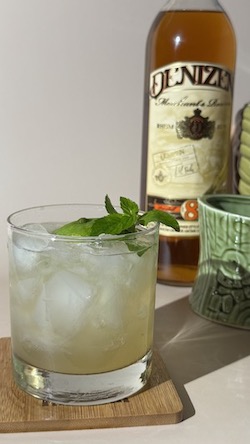
Denizen Merchant’s Reserve was created specifically for making a Mai Tai in the spirit of the original Mai Tai that tiki icon Trader Vic invented in the 40s. While Trader Vic’s official recipe has always been a secret, and if I understand correctly, the rums from that old recipe don’t even exist anymore, Denizen is a meticulous attempt to nail that original blend as closely as possible.
Nick Pelis of Citizen Spirits, creator of Denizen Merchant’s Reserve, worked closely with Martin Cate of Smuggler’s Cove fame, along with contributions from other leading rum experts, to craft this special blended rum. It’s a magical ingredient that makes an absolutely killer Mai Tai.
The other liquor in the recipe above is a dry curacao. Curacao is an orange liqueur, along similar lines as a Cointreau or a triple sec, but drier, with a strong bitter orange peel character, and made from a brandy base. The Pierre Ferrand brand plays very well with a high quality rum like Denizen. It brightens a Mai Tai, providing depth and richness, and adds a sweet spicy orange peel flavor, serving as the bridge between the rum and the lime citrus. It’s a critical ingredient here, so you don’t want to skimp on it. You’re not going to get that added complexity with just any orange liqueur like a run-of-the-mill triple sec or even a lesser curacao.
If you’re new to the Mai Tai, you may not be familiar with orgeat syrup, but it’s where a Mai Tai gets its delicate almond flavor, along with some floral aromatics and a bit of sweetness. It also softens the tartness of the lime and gives the Mai Tai its silky mouthfeel. We’ll talk more about orgeat in a bit.
The lime is, of course, key to the Mai Tai in the same way citrus is the heart and soul of any sour like a daiquiri, margarita, etc. Paired with rum, it makes a Mai Tai a truly tropical experience. As with all cocktails, freshness of the juice is paramount, so invest in a good handheld citrus squeezer or sturdy countertop juicer. If you’re just dipping your toe into the tiki world or merely a little tiki curious, a citrus squeezer should be the top item on your shopping list.
The simple syrup is there to assist the curacao and orgeat syrup in slightly sweetening the drink to mellow the acidity. You can tweak the amount as needed, based on how much sweetness you’re getting from the other ingredients, which will vary by the brands you choose. In the recipe above, we went low on the simple since the orgeat brand we used tends to run sweet.
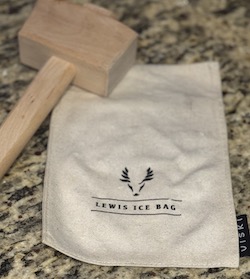
Crushed ice is a staple in tiki drinks, and I’d once again refer you to Martin Cate’s Smuggler’s Cove for some real in-depth knowledge on ice best practices, from shaking with ice to proper presentation in your drink to the myriad ways to crush your ice. But if you’re just getting started, I recommend picking up a Lewis bag and a mallet. A Lewis Bag is a sturdy small canvas sack that you fill with ice, and then you pound the hell out of with a mallet. It’s the old school way of making crushed ice and allows you to dial in the amount of crush to your liking.
Finally, the garnish. The lime shell and mint garnish come from the Smuggler’s Cover recipe, and as explained in that book, the mint is not just decor, but a critical aroma addition to the Mai Tai profile. It is, however, an awesome piece of decor, too, pairing with the lime shell to resemble a little island with a palm tree, as per Trader Vic.
Upon initial glance at all the ingredients in a Mai Tai recipe, one might mistakenly take it to be a sweet, possibly over-indulgent beach party pounder, but in truth, it’s a highly refined, balanced cocktail whose every ingredient is critical to the whole. Nothing is arbitrary or excessive. It’s a souped-up sour, and it rules.
On Orgeat…
When I made my first Mai Tai, I had no idea what orgeat syrup was. Do I buy it? Do I make it? Hell, how do I even pronounce it?
The answers to those questions are “Yes, you can buy it”, “Yes, you can make it,” and it’s pronounced “or-zhat.”
Orgeat is a sweet thick almond syrup that adds richness, body and a mild nutty almond flavor to drinks. It was popularized by the Mai Tai, but it existed long before that. The name comes from the French word for barley, “orge”, as the earliest versions from centuries ago were made from barley. Over time, almonds replaced barley, but the name stuck. These days, a basic orgeat recipe consists of almonds, sugars, orange blossom water, rose water, and a touch of brandy or other preservative.
Orgeat was drunk in France and the Mediterranean for centuries, mixed with water, as a non-alcoholic drink. Later discovered in the mid-1900s by our Tiki forefathers to play exceptionally well with other tiki ingredients, it became a core component in many of the classics like the Mai Tai, Saturn, and Fog Cutter.
In the recipe above, I used a bottle of Fee Brothers that had been hiding in my liquor cabinet. Fee Brothers could be considered sort of a middle-of-the-road brand of orgeat. Not necessarily the top choice for true Tiki aficionados, but a dependable, easy to find product from a company that’s been around for decades. Fee Brothers is a little more floral, sweeter, and lighter on the almond richness than some of the more popular ones in tiki culture, such as:
- Liber & Co: One of the most recommended amongst tiki enthusiasts, with all natural ingredients and a rich roasted almond flavor.
- Latitude 29 Formula: Based on the house recipe from Latitude 29, the famous New Orleans tiki bar, founded by famed tiki historian, Jeff “Beachbum” Berry. Rich, creamy, and very almond forward. A primo tiki ingredient from a modern tiki god.
- Small Hands Foods: These guys are pioneers of the craft cocktail movement, producing high quality history-inspired ingredients. A top pick by industry pros.
Origin Story:
You can’t really talk about the origin of the Mai Tai without talking about the origin of tiki, so I’ve thrown together a super-slimmed down primer here. There are plenty of great books available that provide a much more thorough and entertaining dive into the world of tiki. Check out the “Sources and Further Reading” section at the bottom of the post for a few great ones..
Don the Beachcomber and the birth of Tiki…
In 1933, a fellow named Earnest Raymond Gantt, after spending years traveling throughout the Caribbean and South Pacific, opened up a small bar in Hollywood called “Don’s Beachcomber.” The restaurant was filled with tropical and nautical decor inspired by his travels. The drinks, shunning that era’s conventions of one or two spirit simple cocktails, were complex affairs with multiple rums, fresh citrus, house-made exotic syrups and spices. Built around a Polynesiasn vibe, “Don’s Beachcomber” offered a temporary getaway from the Great Depression and all the other heavy shit going on out in the real world, and the public loved it.
And, thus, the first “tiki bar” was born.
A few years later, Gantt moved across the street to a bigger locale, renaming it “Don the Beachcomber” and including a restaurant. Gantt continued to refine his own persona as well, dubbing himself “Don the Beachcomber,” and eventually legally changing his name to Donn Beach.
Enter Trader Vic…
A few years after Don the Beachcomber opened, a new tiki titan entered the scene. Vic Bergeron, later known as Trader Vic, was a Californian restaurateur who opened his own version of a Polynesian-themed restaurant, “Trader Vic’s,” which had a similar tropical/escapist aesthetic as Donn’s restaurants, but the cocktails leaned more towards simpler recipes and high quality spirits (rum, mostly).
In 1944, Trader Vic gave birth to the mighty Mai Tai. Legend has it that the name comes from a visiting friend from Tahiti who took a sip of Vic’s newest creation and exclaimed “Maita’i roa ae!”, which roughly translates to “Out of this world! The best!” And the name Mai Tai stuck.

Tiki’s Expansion and Contraction…
Tiki culture flourished in the post-World War II days, as the economy boomed and servicemen returned home from the Pacific with new tastes that they’d acquired from their time abroad. Tiki and its escapist staycation-styled restaurants pierced the zeitgeist, thrilling revelers with their bountiful rum stock, over-the-top cocktails, and their exotic rituals and drinking vessels. By the 50s and 60s, tiki restaurants were dotting the American landscape and making their way across the sea.
At the height of tiki in the 60s and early 70s, there were roughly two dozen Trader Vic’s restaurants worldwide, stretching from California across the U.S, over to London, Tokyo, Hong Kong, Sydney and throughout the Pacific. Don the Beachcomber had expanded to 16 locations during Donn Beach’s lifetime, and even more later via licensing of the brand.
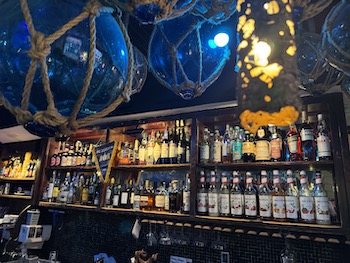
There were 100s of other similar tiki/polynesian-themed restaurants all across the U.S. And the movement wasn’t unique to just restaurants. People were building tiki bars in their backyards and basements. Tiki bars were popping up in hotels, motels, even bowling alleys. For a good two decades, it was a full-blown pop culture explosion of escapism.
Of course, as with everything that reaches peak popularity, it soon attracted the copycats with their lazy imitations of tiki who diluted the purity of the movement with bastardized, dumbed down versions of the classic tiki cocktails.
And by the late 70s and early 80s, the tiki movement had lost its momentum. People were moving to more casual dining experiences and to a simplified drinking culture that celebrated vodka drinks, wine coolers, lite beers, and pre-made mixes over fancy, showy, complex cocktails. As public apathy for tiki grew, tiki culture was soon treated as just another kitschy relic of the recent past, suffering a similar fate as disco.
Today only two Trader Vic’s remain. The flagship in Emeryville, CA, and our beloved one here in Atlanta in the basement of the downtown Hilton.

The Renaissance…
All was not lost…
In the 90s and early 2000s, a renewed passion for tiki started to gain steam, with bartenders and cocktail historians like Martin Cate and Jeff “Beachbum” Berry parsing countless old recipe books and bar records for the secrets to recreating the original tiki classics. Kind of an offshoot to the larger cocktail revolution that was taking hold in major cities. Bars such as Smugglers Cove, Latitude 29, Three Dots and a Dash soon began to pop up, introducing a new audience to tiki culture, rum appreciation, and the joys of exotic rum-heavy citrus drinks that had captured the imaginations and palettes of the previous generations.
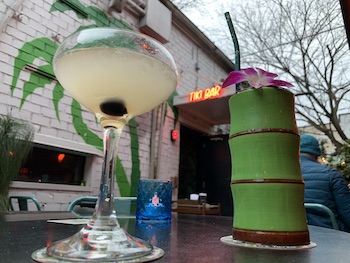
And thanks to this new Tiki renaissance, I have the good fortune of being able to take a short walk into downtown Decatur, GA, belly up to the bar at S.O.S. Tiki Bar, and order a lovingly-made, absolutely delicious Mai Tai.
Recipe Rationale:
Denizen Merchant’s Reserve rum: I already spoke about Denizen above and why it’s a perfect Mai Tai rum, but if you can’t get your hands on a bottle for some reason, just get your hands on a copy of the Smuggler’s Cove book and you’ll find recommendations for plenty of other blended aged rum that you can use as well.
Fresh lime juice: Fresh is key. If it ain’t fresh, it ain’t a real Mai Tai.
Pierre Ferrand Dry Curaçao: Pierre Ferrand is a great brand and this is a great curacao.
Fee Brothers orgeat syrup: As mentioned above, I went with this brand because I already had it, and it works just fine, but I do feel like it didn’t give my Mai Tai the same punch as some of the other brands I’ve tried, like Liber & Co.
Simple Syrup: This is the easiest ingredient to tweak the sweetness of your Mai Tai to your tastes. Since Fee Brother orgeat is pretty sweet, I kept this addition low. It’s worth noting that the Smuggler’s Cove recipe uses a homemade syrup with demerara sugar instead, and I find that the demerara does make a slight, but noticeable, improvement in the Mai Tai. But simple syrup’s just fine if it’s what you got.
Verdict:
“Bones went rogue on this one and didn’t make me one, but I’ve had his Mai Tais before and am a fan. Very tart and fresh! I was supportive of his temporary tiki obsession, but probably best that it didn’t go on for too long. He doesn’t need any more flowered shirts.”

Sab
“While this recipe does make a damn fine Mai Tai, I can’t help but notice that it’s lacking a little something from what I remember from the Smuggler’s Cove recipe. I suspect that’s from my use of a less exciting orgeat syrup, and simple syrup instead of demerara. Still, though, it’s a solid recipe that makes a solid Mai Tai. ”

Bones
Sources and Further Reading:
Books:
Cate, Martin, and Rebecca Cate. Smuggler’s Cove: Exotic Cocktails, Rum, and the Cult of Tiki
Pietrek, Matt and Carrie Smith. Minimalist Tiki
Curtis, Wayne. And a Bottle of Rum
Web:
Leave a Reply