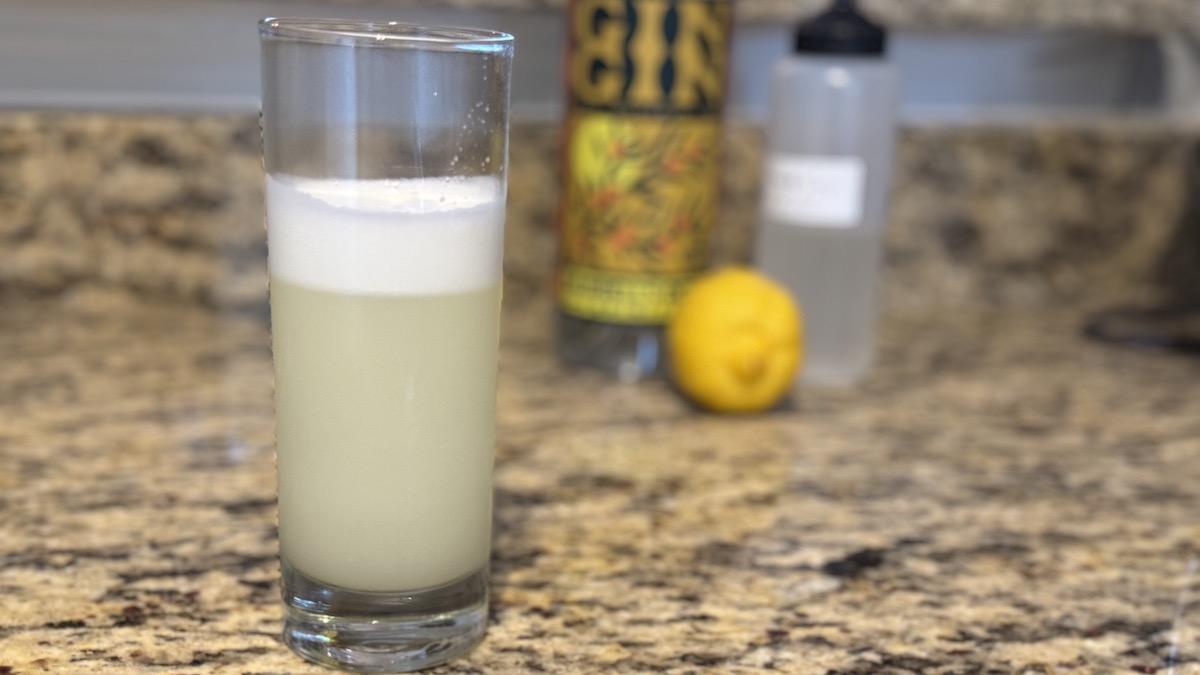
The twentieth entry in the series where my wife Sabrina and I journey through the wide wonderful world of classic cocktails by crafting and drinking recipes together at our home bar. Today let’s get back to basics with the soft, satiny sour served under a splash of soda, the Gin Fizz.
Recipe:
- 2 oz Murrell’s Row Gin Gin
- 3/4 oz Fresh lemon juice
- 3/4 oz Simple syrup (1:1)
- 1 Egg white
- 2 oz Cold soda water
Add the gin, lemon juice, simple syrup and egg white to a shaker without ice and give it a good hard “dry shake” (approx. 15 – 20 sec). Add ice to the shaker and thoroughly shake again (approx. 15 – 20 sec). Strain into a chilled collins glass without ice. Top with soda water. Give it a quick stir, but go easy on it so you don’t release the carbonation from the soda water.
Intro:
Ah, the classic fizz cocktail, a bright and light, tart and slightly sweet, refreshing drink with a creamy foamy head. A sour with soda on top, really. And optionally an egg. Ardent readers may point out that I used a similar choice of words to describe a Tom Collins, minus the egg. Indeed, and not just because I’m a lazy wordsmith, but because it’s an apt description for both of these drinks that are strikingly similar in recipe, yet which each possess their own distinct characteristics in process and proportion. We’ll get into that in a bit.
Prior to beginning my exploration of classic cocktails, I had no experience with fizzes. I knew the name, and presumably I presumed that their name meant that they were fizzy. Or maybe I didn’t even think that hard about it, which I probably didn’t. I guess I could try now to remember whether I did or did not think that hard about fizzes in the past, but that would require me to think hard, and why start now. Well, unless I already had started thinking hard back when I first thought about a fizz, in which case now is a perfect time to stop thinking hard. Either way, suffice it to say that I don’t know shit.
Nonetheless, the name Gin Fizz always sounded to me like an old person cocktail (note: that was in the past, as I am now old). Something my grandparents would drink. I said the same thing about a Tom Collins. And I guess my senses weren’t too far off, considering that they are both classic cocktails and they are both very similar drinks. And that’s a perfect segue into a discussion on a fizz vs. a collins, ain’t it?
Booze Basics:
Let’s leave the egg out of the discussion for a minute, since it wasn’t even an ingredient in the early days of the Gin Fizz, and let’s hash this drink out. If a fizz is a sour with soda water on top, and a collins is a sour with soda water on top, then what’s the dealio? Some articles will say that it’s the egg that is the differentiator between the two, but damn it man, I just said we’re not going to talk about the stupid egg right now!
So what else then?
First, there’s no ice in a fizz whereas a collins is full of ice cubes, and that’s important because as we go on, we’ll see that a Gin Fizz is treated as more of a relaxing, elegant drink vs the refreshing afternoon-friendly Tom Collins.
Second, a fizz is shaken. A collins is traditionally poured and stirred right in the collins glass, or said in a cooler way, “built in the glass.” Worth calling out that I didn’t mention this in my Tom Collins post, and in fact my Tom Collins recipe calls for shaking the ingredients before adding soda. That’s because I was playing 4D chess and you fell right into my trap. Just kidding, I didn’t realize that a traditional collins was stirred.
Third, while the ingredients are the same, the proportions are different. Most importantly, there’s more soda water in a collins, making it a tall, refreshing drink. A fizz has enough soda water to make it carbonated and easy drinking, but not enough to want to mix yourself up one after mowing the lawn.
The other differences in ingredient proportions are mainly around balancing the drinks to account for these dilution differences. The ice in a collins will slowly melt over the course of the drink’s life, and thus the flavor will slightly change over time. The ingredients are balanced to take into account that it’s a “moving” drink. The flavors of a fizz, which is iceless, will be locked in at the beginning.
In short, while the ingredients are close to identical, there are differences in proportion and preparation to make a Tom Collins a crisp, refreshing slugger in the sunlight and a Gin Fizz a creamy, luxurious drink with dinner.
So, let’s quickly summarize:
- Sour: Spirit/citrus/sweetener
- Fizz: Sour + soda
- Collins: Sour + lots of soda + ice + length
While we’re having fun with this, go back and check out the French 75. It’s basically a Gin Fizz that gets its bubbles from champagne instead of soda. Egg not withstanding, of course. Get off my back about the damn egg.
Speaking of the damn egg…
The Damn Egg:
While the original Gin Fizz did not include an egg white, it has become a defining part of the modern version. The egg white is what gives a fizz its soft, velvety mouthfeel and its creamy meringue pie-like head. It doesn’t add any flavor, it’s just for texture. And, I guess, a source of protein and essential vitamins and minerals?
When adding an egg white to a drink, it’s important that you “dry shake” it first, which is just shaking the cocktail ingredients in a shaker without ice. This will emulsify and froth the ingredients, making your drink fluffy and soft. You’ll then follow up with a regular shake with ice to chill the drink and dilute it slightly, but that initial dry shake is how you get the texture that you want.
As mentioned above, the original Gin Fizz did not contain any egg. Since our recipe above contains egg white, it’s technically called a “Silver Fizz.” Use the egg yolk instead and you’d have a “Gold Fizz.” Use the whole egg, without the shell of course, and you’re drinking a “Royal Fizz.” Throw the whole damn egg in there, shell and all, and you are clearly drunk and/or hungover and you’re making a “Fuck It Fizz.”
Note that I just made up that last one, but I think it has legs. You’re welcome to use the name next time you find yourself with a whole shelled egg sitting in your shaker. Also, you might consider reeling in your drinking a bit.
Origin Story:
Per liquor.com, the fizz cocktail dates back to the late 1800s when carbonation was still a fairly new invention and everyone was gushing over it (sorry). Fizzes first appeared in print in Jerry Thomas’s 1876 The Bar-tender’s Guide. After that, they really took off with the drinking class who would consume them as an end-of-the-night relaxer, and their popularity continued throughout the pre-Prohibition era.
Several variations on the fizz template came later, such as the Ramos Gin Fizz, invented by Henry C. Ramos in New Orleans, adding cream, orange flower water, egg white, and a famously large amount of shaking.
Although gin seems to be the spirit most commonly associated with a fizz, it didn’t start that way. There were gin fizzes, whiskey fizzes, brandy fizzes, rum fizzes… If a spirit tasted good with citrus and sugar, you’d likely find a version with soda water dumped on top of it. Gin probably became the most common fizz spirit since it goes so well with lemon and carbonation, and since it was such a widely consumed spirit back in the day.
Going back to the fizz vs. collins angle, there’s not a clear delineation, but collins appears to have shown up first, likely as an evolution from earlier gin punch recipes, Fizzes would have entered the timeline shortly after as a more techniqued style than the looser collins.
Recipe Rationale:
Murrell’s Row Gin Gin: As you well know by now, this is my go-to when a recipe calls for a London Dry style of gin, and I love all of Murrell’s Row’s offerings. Local to my home of Decatur, GA, they have some stellar gins out on the market and an Amaro that I drink the hell out of. If you can’t get a bottle of Gin Gin, any decent London Dry like Beefeater will do you right for this drink. .
Fresh lemon juice: Same thing I always say – squeeze your juice fresh. If you don’t already have a citrus squeezer, this one works well.
Simple Syrup: No need to buy this. You can make your own with granulated sugar and water. It’ll stay good in the fridge for a month or so. Here’s a simple recipe.
Egg white: As mentioned above, this is optional, but it makes a significant change in the texture, mouthfeel and foam. Worth the extra effort to include it.
Soda water: I just used seltzer water from Lidl. Worked fine. I love Lidl. Sab and I always do our grocery shopping there, and they have three aisles full of the most random crap from sweat pants to fondue sets that excites me every time we go.
Verdict:
“Not bad! Really nice gin flavor.”

Sab
“The soft, pillowy mouthfeel was quite nice. The head was thick and bright white, and reminded me of a Guinness, an observation that I thought was profound. Conveniently, I had a fresh pint of Guinness on the kitchen counter so I was able to visually compare the two heads in realtime, and well, not really the same at all. Oh well. Taste-wise it was very pleasant and easy drinking. Tasted just like what it is – a more refined, silky Tom Collins with a frothy head and no ice. Will happily make this one again.”

Bones
Next (Coming Soon) >>
Leave a Reply