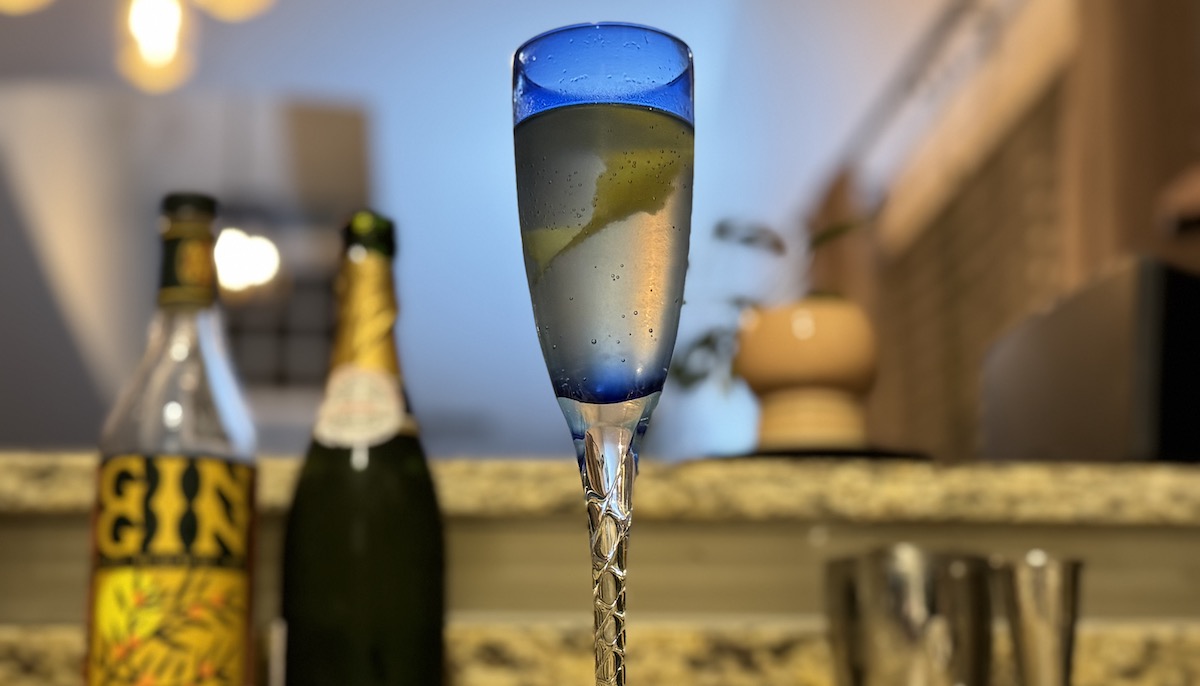
The seventeenth entry in the series where my wife Sabrina and I journey through the wide wonderful world of classic cocktails by crafting and drinking recipes together at our home bar. Today let’s have a look at the luxurious lemon bubbly brunch libation, the French 75.
Recipe:
- 1 oz Murrell’s Row Gin Gin
- 1/2 oz Fresh lemon juice
- 1/2 oz Simple syrup (1:1)
- 3-4 oz Chilled Brut champagne
Add the gin, lemon juice, and simple syrup to a shaker with ice. Shake hard to chill and integrate the ingredients (10 seconds or so), and then strain into a chilled flute glass. Top with champagne and stir, but just a quick stir because you don’t want to disturb the carbonation. Express a lemon twist over the top and drop it in.
Intro:
As I’ve mentioned numerous times before, I spent the vast majority of my drinking history as a beer guy and didn’t get excited about cocktails until late in the game. I do, however, clearly remember mixing up a French 75 back in the late nineties. My buddy hJon and I were roommates in our first post-college apartment and we decided we’d throw a Christmas party and that we’d even class it up a bit with a couple punch bowls of fancy drinks to complement the keg of crap beer.
I should quickly note that “hJon” is not a typo. That’s his name. Well, his acquired name. His real name is John, but whenever the guys and I would write his name down on a check or a Post-In note or whatever, we’d address it to “Jon.” One day he scolded us for excluding the “h” from his name.
“My name is John!” he proclaimed. “Not J-O-N, but John! With an h!”
“Ok, man, that’s our bad,” we responded. “We’ll give you the h. But it’s going up front.”
And thus, he forever became hJon.
So anyway, hJon and I decided to throw a party and make some fancy communal drinks. One would be a boozy egg nog, and for the other, well I asked my dad what would be an upscale cocktail to serve. He recommended French 75. I’m not sure why he thought this would be a good drink to provide a small apartment packed full of young dumb early 20-somethings who were still in their “drink until you fall down” phase, but I’m going to bet he didn’t even remember what it was and just thought the name sounded classy because it had “French” in it.
But nevertheless, that’s what we made. A big ass bowl of French 75, likely mixed with the bottom-est shelf gin, cheap frozen lemonade from concentrate, and I’m sure we poured cheap champagne right into the punch bowl and let it sit out the entire night so that party goers were treated to a Solo cup of what amounted to a bad gin and lemonade mix with hints of flat champagne. Oh, and then chased down with some very runny, eggy, schnapps-drenched nog.
I don’t remember any of the party. Only that it hurt.
And that was my last French 75 until this one here.
Booze Basics:
So, if my boy hJon and I, being the wiser and far more sophisticated fellows that we are today, were going to make ourselves a French 75 now, we’d procure a good bottle of gin and we’d forgo the lemonade concentrate for fresh lemon juice and simple syrup. And in doing so, we’d suddenly realize that we were simply making a gin sour topped off with champagne.
We’d then maybe realize that it’s the same ingredients as a Tom Collins, except that a Tom Collins is topped off with club soda instead of champagne. We’d discover that the French 75, like the Tom Collins, is but another example of a cocktail that simply branches off the basic sour template (spirit, citrus, sweetener).
In fact, hJon and I might have been wiser to serve Tom Collins instead of French 75 at our little 90s soiree/shit show. Although a Tom Collins recipe often calls for twice as much gin as a French 75, it ends up being a lower alcohol beverage (10-12%) due to dilution from all the club soda and the ice, whereas a French 75 lands in the 14-16% range from that extra 3 or 4 oz of champagne. Realistically, either one is gonna clean your clock if you knock back Solo cups full of it like they’re warm foamy Miller Lites from the keg, though, so my recommendation is to not do that.
Morning Drinks vs. Day Drinks (Revisited):
In my recent post about the Pimm’s Cup, I waxed philosophical on the difference between morning drinks and day drinks and I really didn’t offer up any useful guidance, and I’d like to go ahead and do some more of the same.
See, a French 75 is generally considered an evening drink, but it has also made its way into the morning category, as sort of an elevated alternative to a Mimosa. If you order a French 75 at brunch, you’re a brunch pro. But you can’t order a Tom Collins, the other lemony gin sour-based cocktail, because that’s a daytime drink. Why is one ok and the other taboo? Well, it must be because of the champagne, right?
Champagne is allowed in the morning, but only if it’s mixed with orange juice (Mimosa) or mixed with a gin sour (French 75). You can’t drink it alone in the morning, unless you want people to look at you like you’re still up from the night before and you’re still wearing your New Years Eve tiara and have eye liner dripping down your face.
Interestingly, you can drink club soda in the morning. But you can’t drink it if it’s mixed with a gin sour (Tom Collins). You have to wait a few more hours until it’s officially day before you can do that. For some reason.
Of course, all of these rules are rendered null and void if you’re in an airport. You can order a Pabst and a whiskey chaser at 6am if you’re in an airport, and the guy slurping down his omelette next to you won’t bat an eye.
Anyway, I remain perplexed by the slippery rules that govern a morning nip, but I can confirm that a French 75 is allowed. Well, it’s allowed in a specific type of glassware…
Glassware:
I don’t want to speak on hJon’s behalf, but if he were to make a French 75 today, I suspect he would not pour it into a Solo cup like we did at our party in the 90s. He’d probably serve it in a tulip, or champagne, glass. That’s usually how they’re served these days, and for good reason. A tulip glass is tall, and more importantly, slender, which helps to preserve the carbonation from the champagne.
You may also sometimes see a French 75 served in a tall, slender, non-stemmed glass like a collins glass. Sometimes with ice cubes. While that’s a fine solution for preserving carbonation and it looks nice, if you ask me, you’re now creeping all up into Tom Collins’s business. So I’m on Team Tulip.
Without doubt, if you order a French 75 at brunch, it’s gonna come in a tulip glass. I’m pretty sure that if they served it to you in a collins glass, they’d tell you that it’s currently off limits and you’re only allowed to look at it until you finish your brunch and then order lunch, thereby officially making it day and making it safe to consume. I’m not sure why though. I hate this.
Origin Story:
As with almost all the classic cocktails, the origin of the French 75 is debatable, but everyone seems to agree that it is named after the French 75mm field gun used in World War I. The drink itself likely originated in Harry’s New York Bar in Paris during WWI, which you might recall is also when and where the Sidecar was invented. If, of course, this origin story for both drinks is correct.
As one who is admittedly very unstudied in both military history and cocktail history, my expert opinion (see “Dunning Kruger Effect”) is that this history checks out. Original versions of the French 75 were made with cognac, reportedly, so it makes sense to me that the same bar could be kicking out multiple new cocktail creations with a cognac and lemon juice base and with military inspired names.
But if you’d like to get accurate history from a true cocktail historian and not just some asshole like me who spent maybe 5 minutes on google before solidifying his beliefs, check out David Wondrich if you’re not already familiar.
According to Food & Wine, the French 75 first appeared in print during Prohibition in the 1927 book titled Here’s How, but it really took off after appearing in Harry Craddock’s 1930 The Savoy Cocktail Book. By the time it made it into Savoy, it was a gin-based cocktail.
Recipe Rationale:
Murrell’s Row Gin Gin: As with all cocktails that call for gin, I go with my favorite distillery, Decatur GA’s own Murrell’s Row. Gin Gin is their take on a London Dry gin, and it’s exceptional. If you can’t get your hands on it, though, you’ll be fine with any decent London Dry like Beefeater, Tanqueray, etc.
Lemon Juice: Freshly squeezed lemon juice is key. Don’t be like the 90s version of Bones and hJon and try to sneak in some grocery store canned stuff, or else you might as well just go the whole 9 yards and pound it from a Solo cup. Get yourself a handheld citrus juicer. It will take you far.
Simple Syrup: Simple syrup is quick and easy to make and it will stay good in your fridge for a few weeks.
Champagne: Using genuine champagne is historically accurate, but any dry brut sparkling wine should be fine. Don’t go with extra dry, though, since those are sweeter. I can’t remember what I went with, but I do know that it was something very reasonably priced that I picked up from Lidl, along with some socks probably. Worked just fine for me. The champagne, I mean. Well, and the socks.

Verdict:
“I love a French 75! This one was nice! I could have drunk it down in one sip. Very tart and lemony. There was gin in there?”

Sab
“Tart and lemony indeed! An elegant bubbly lemonade. The gin was faint, but I could definitely taste it. Could it have used a bit more? Maybe. But the drink was very good and very easy to drink. Too easy, perhaps. I do think this would be an excellent brunch cocktail and would go great with sliced salmon, but I’ll never know because I rarely brunch and when I do, I order the same thing every time which is not salmon.”

Bones
Next (Coming Soon) >>
Leave a Reply