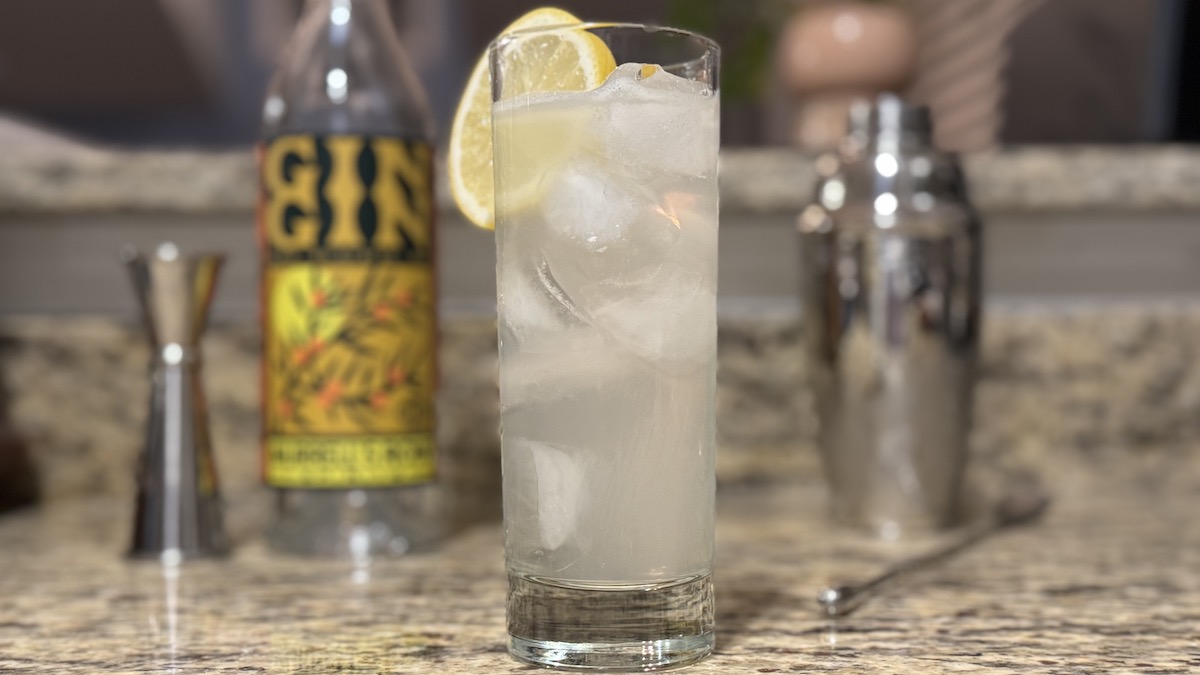
The thirteenth entry in the series where my wife Sabrina and I journey through the wide wonderful world of classic cocktails by crafting and drinking recipes together at our home bar. Today let’s dive into a drink that’s oft overlooked these days but would make a perfect pool-side pounder, the Tom Collins.
Recipe:
- 2 oz. Murrell’s Row Gin Gin
- 1 oz. Fresh lemon juice
- 1/2 oz Simple syrup
- 3-4 oz Club soda (Basically to the top of the glass)
- Garnish: Lemon wheel
- Garnish (optional): Maraschino cherry
Add the gin, lemon juice and simple syrup to a shaker filled with ice. Shake briefly, just enough to chill the ingredients and mix them together, but you don’t need to beat the hell out of it. Strain into a Collins glass filled with fresh ice. Top with cold club soda. Give it a gentle stir. Garnish with a lemon wheel and an optional Maraschino cherry.
Intro:
If you’ve been reading my “Making Classic Cocktails at Home” posts in order, then you may have noticed that my last three entries (Margarita, Moscow Mule, Tom Collins) have formed a theme: “Perfect summertime drinks that Bones made in the dead of winter!” That was not intentional, nor desired. It’s been abnormally freezing cold here in Georgia lately and we Georgians are abnormally unequipped to handle the cold, so I’d much rather be drinking a stiff whiskey-based cocktail or a hot toddy to get through this rather than a refreshing, ice cold Tom Collins. In my defense, up until now, I didn’t know what the hell a Tom Collins was.
I’d certainly heard of a Tom Collins, and I probably would have correctly guessed that it was something light and gin-based, but other than that, nothing. It’s a drink I associate with old people. And now that I’m old, I guess I more accurately associate it with people who were previously old when I was young but are currently dead since I’m now old. To me, it’s a drink that I probably watched my grandma whip up for my curmudgeonly grandpa when we were visiting in the 80s to get him to stop barking at me and my brothers as we trashed his house. But I’ve never ordered one or even seen anyone order one.
Actually, I take that back. If memory serves, my buddy Freaky ordered one at a beachside party bar in Daytona, FL back in the mid 90s because he wanted the pretty waitress to think he was a sophisticated cocktail guy and not a guy who really just wants to pound Vodka Redbulls and Miller Lites. It was the first cocktail name that he could think of. He didn’t even know what he was going to get, and after he got it, he didn’t even know what he got. Oh, to be young again.
Booze Breakdown:
So, what kind of drink did Freaky actually receive, assuming the bartenders didn’t just grab a random drink off the bar and send it to him, knowing he’d not know the difference?
Well, if you look at the recipe, you’ll see a Tom Collins is composed of gin, lime, and simple syrup, which you may remember is the classic sour drink pattern (spirit, citrus, sweetener). It’s a Gin Sour, in fact. So, a Tom Collins, simply put, is a Gin Sour in a tall glass of ice, with club soda on top.
All of the Collins drinks, generally speaking, are a variation of a base spirit mixed with lemon and sugar/simple syrup, lengthened with club soda. Tom Collins uses gin as the base spirit, John Collins uses whiskey, Vodka Collins uses vodka, etc.
Then you can expand upon this pattern game with a Fizz, which also is a sour with club soda, but with less club soda, and with a lot of shaking to adjust the texture.
To summarize, in high level “classic” terminology, you can think of it like this:
- Sour: Spirit, Citrus, Sweetener.
- Collins: This same sour “lengthened” with club soda. Served “tall”. Refreshing and crushable.
- Fizz: Also the same sour with club soda, but less club soda. Served short. Shaken for texture and integration. Compact and elegant.
I used the term “lengthened” above because a Collins is often called a “long drink,” which means it’s been mixed with club soda (or similar), which dilutes it and lowers the overall alcohol content, making it more refreshing and more of a drinker than a sipper.
Cool, that was fun. Now we understand a Collins. But then, what the hell is a Collins glass?
Collins vs. highball:
Well, if you’re like me, a Collins glass is that glass behind the bar that you instinctively thought was a highball glass, because a Collins glass is tall and narrow, and “highball” sounds like something that would be tall and narrow. Right? Or is that just me?
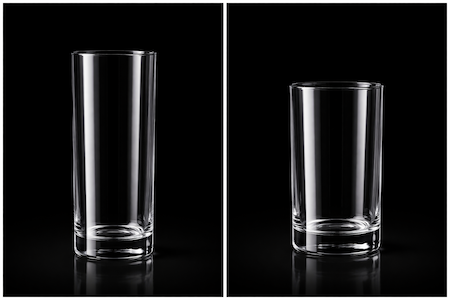
Anyway, like I said, a Collins glass is a tall, narrow glass with straight sides that looks kind of like a tube. It typically holds 10-14 oz, and was designed for drinks with ice and two or more ingredients, one of them being carbonated liquid. It’s used for Collins drinks (shockingly).
A highball, on the other hand, is also tall and narrow, but less tall than a Collins glass. It typically holds 8-12 oz, and was designed for drinks with ice and only two ingredients (thus needing less volume than a Collins glass). It’s used for drinks like a Gin & Tonic.
Here’s a pic that I asked ChatGPT to make, with a Collins on the left and a highball on the right:
The design of the Collins glass serves a few purposes:
The glass’s narrow diameter and narrow mouth reduces the amount of the drink’s surface area that makes contact with the air, slowing the escape of CO2 from the club soda. This keeps your cocktail carbonated longer.
The narrow mouth also retains the aromatics more than, say, a rocks glass that lets the aromatics flow freely up to your big nose. Aromatics are less important in a Collins, where we’re aiming more for crispness and refreshment that we’ll get by maintaining the bubbles.
The narrow shape of the glass allows the ice cubes to stack vertically which reduces the amount of ice surface area that comes in contact with the liquid and also reduces the opportunity for the ice to move around in the glass. This slows the melting of the ice and, thus, the dilution of the drink. Accordingly, as the ice does start to melt, the narrowness helps the soda to integrate more consistently into the solution, keeping it proportional within the drink.
That’s probably enough glass talk for now. I personally went down a minor rabbit hole during my reading and I’m sure I’ll obsess on this going forward, but suffice it to say that if you’re not neurotic, you’ll be fine with whatever glassware you got. In fact, it’s quite common for bars to have a single glass type to serve as both their Collins and highball.
(Btw, a lot of the above hot glass talk comes from a great liquor.com article that’s also included in the links at the bottom)
Origin Story:
The birth of the Tom Collins cocktail dates back to the mid 1800s, likely originating in London. Liquor.com, sharing info from the almighty cocktail historian David Wondrich, says the drink is probably an offshoot of old gin punches that were popular in the day, and that a London bartender, John Collins, originally named the drink after himself. Since the early recipes called for Old Tom gin, that likely led to a tweaking of the name from John to Tom over the years. The first printed version of the recipe was in Jerry Thomas’s legendary 1876 Bar-Tenders Guide.
In 1870s New York and Philadelphia, a popular practical joke arose from the drink’s name. A prankster would tell his friend that “Hey, some guy named Tom Collins is talking shit about you at the other bar. You know him?” Well, I guess this was back in the late 1800s, so it would be more like, “Hark! Some guy nameth Tom Collins talketh shit about thy. Dost tho knoweth him?” That’s how we talked back then, right?
Anyway, the prankster would tell this to the prankee, who would get pissed and march over to the other pub and start asking for this Tom Collins asshole with the big mouth, only to learn that Tom was just a drink.
This elaborate “hoax” became hugely famous, with local newspapers even amplifying it by reporting wild claims of Tom Collins sightings.
I’m probably leaving out some critical details to the story because it feels a little, well, underwhelming as far as bar pranks go. Or maybe we just needed 150 years of drinking evolution to arrive at our pub prank pinnacle of today: Smirnoff Icing your bro.
Recipe Rationale:
Murrell’s Row Gin Gin: Original Tom Collins recipes called for Old Tom gin, but over time, London Dry took over as the standard. As I’ve mentioned numerous times before, Murrell’s Row is an awesome distiller here in Decatur, GA, and Gin Gin is their take on a London Dry. I always have a bottle on hand in my liquor cabinet. I love it.
You’ll do fine with any straightforward, not overly flowery gin. Beefeater, Tanqueray, Plymouth appear to be commonly used.
Fresh lime juice: As always, don’t use bottled lime juice. Squeeze your own. Get yourself a citrus squeezer and you’ll never buy one of those green plastic lime-shaped bottles again.
Simple syrup: You can buy simple syrup, but it’s easy to make your own. That’s what I do, and it stays good in the fridge for at least a few weeks.
Club soda: I just used a bottle of Canada Dry and it worked just fine. Feels like there was a glass bottle of Canada Dry on every wet bar when I was a kid in the 80s, which makes it appropriate for a drink I associate with back then. I’m sure it’s possible to nerd out on club soda and I’m sure I’ll do it at some point. It’s just lower in my queue of things to over analyze and stress about. All in good time, my friends. All in good time.
Verdict:
“Tastes like a spring day with a refreshing thunder storm. That’s what I came up with based on a single sip of Bones’s drink since I’m still doing Dry January.”

Sab
“Yeah I don’t do Dry January. I did do a Dry January 29th I think. Anyway, this drink is as refreshing and easy drinking as the recipe would suggest. As light as it was, the gin still shined through, just right on top of the sour from the lemon, as a friendly reminder that this is indeed a booze drink. A light, bright, sparkling alcoholic lemonade. Certain to be a contender on future hot days when I’d normally pour a Gin and Tonic.”

Bones
Further Nerdery:
I got some excellent info on glassware and Tom Collins history, along with recipe inspiration, from the links below. All great reads. Give ‘em a visit!
- Allrecipes “Tom Collins Cocktail”
- Liquor.com “Tom Collins”
- Liquor.com “Highball vs Collins Glasses: Why There’s a Difference, and Why It Matters”
- Masterclass “How to Make a Tom Collins: Classic Tom Collins Cocktail Recipe”
Leave a Reply