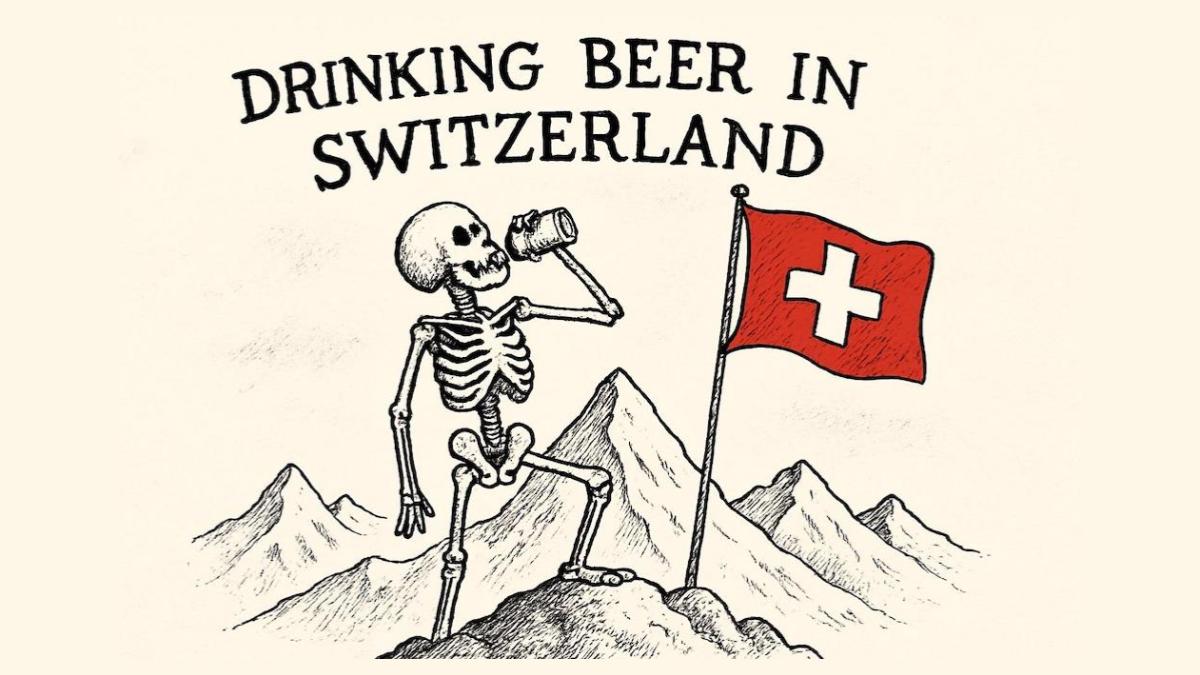
My wife Sabrina’s side of the family lives in Switzerland, so she and I have made quite a few visits to the beautiful country to see them over the years. Not a bad place to spend time with the in-laws, if you ask me. Sab and I were just out there for a couple weeks over the Christmas holidays and I made sure to properly utilize my time with a ubiquitous beer in hand, but only to help educate myself on Swiss beers, and not because I lack the ability to moderate my beer drinking. Based on my excessive consumption studying, I’ve tossed together this little write-up on Switzerland’s beer drinking culture as I’ve experienced it over past trips, along with some notes on a handful of the Swiss beers that I sampled in our last visit.
Quick disclaimer that this is written from the perspective of a craft beer dork from the U.S.A, and one that is not terribly cultured in other lands, so I apologize for anything that comes across as overly generalized, or worse, totally wrong. Feel free to correct or insult me in the comments as you so desire.
The best way I can describe beer drinking culture in Switzerland, as compared to the U.S., is subdued. Like so many things in the U.S., our beer drinking culture here is loud and proud. It consists either of folks standing over their large coolers full of macro lagers (Bud/Miller/Coors) proclaiming that one mainstream brand represents American idealism and the others are all commie juice, or it’s craft beer nerds at beer bars decrying the mainstream, taking pictures of their fruited sour and religiously ranking beers by brewery, locale, hipness, rarity, etc.
To be fair, things have settled down quite a bit in the U.S. beer culture over the last few years and there’s a whole range of beer drinkers in between these two extremes, but I still think it’s a decent, albeit overly simple, representation of how our drinking culture is most certainly less subdued than that of our Swiss buddies.
The Swiss aren’t nearly as righteous about their beer as we Americans are. Yes, they’re very proud of their beers, they just don’t get so dang indignant about them. For instance, they have a craft beer scene, but it’s much more reserved, and it’s not so at war with their macrobreweries. Whereas here in the States, our craft brew revolution originated as a direct opposition to the big brands (Anheuser Busch, Molson Coors, etc), and for many years, craft drinkers would outright refuse to drink the macro “swill”, harshly judging those who did (and who in turned would judge right back at the “hipster beer geeks with their rose hip and saffron IPAs” or whatever).
Alas, as the craft beer revolution hit full swing in the U.S., the macros began buying out the smaller, cooler craft breweries, and it was an outrage to those of us who were raised on believing craft beer was the small, passionate rebel force taking on the oppressive global tyrants. Again, all this energy has cooled down a bit over the past few years, and we’ve reluctantly accepted that consolidations and buyouts in the craft space are a normalized part of the industry now, but for a while there it was pretty extreme and very “Screw the Man!” Which is how we Americans like to be.
The Swiss, from my understanding, have not and do not engage in such fiery conflict. They have their version of craft beer, they have their version of regional beers, and they have their macro beers. They’ll select from whichever category, based not on a fierce and unquestioning loyalty to it but rather on what they’re in the mood to drink. Closer to how we might choose a table wine or a tea with dinner – basically, what would go good with the meal or the moment. And if that’s a mega brewery owned by a global corporation or a centuries old regional brewery, it’s all fine. It’s simply not a political thing.
Feels a bit less stressful, to be honest.
And when some of their largest, most iconic breweries were engulfed by the global brands, I would guess that they were a bit disappointed, but overall they remained proud supporters as long as the beer was still brewed locally and still tasted the same. Subdued, indeed.
I would be remiss to not bring up train beers, one of my favorite parts about Switzerland. As you may know, the train system in Switzerland is top notch. You can get pretty much anywhere by train. And it’s clean, comfortable, orderly and on-time. Many of the larger train stations are essentially indoor malls with shops and food kiosks. You are absolutely permitted to pop into one of the mini marts, pick up a can of beer or a to-go wine single, and drink it on the train. You’re treated like adults on the trains, and I have yet to see a single person abuse the privilege. I’m sure to most Europeans it’s a completely ordinary and insignificant occurrence, but to this here American with his sub-par train system and some fairly draconian drinking laws, a train beer is a beautiful thing.
So, all this is to say that the Swiss tend to just drink, and not overthink, their beers as much as we often do in the States, and I followed a similar pattern during my last visit. Pretty much all the beers I drank were bought at the local supermarkets or the train station. I didn’t hunt down any obscure white whale craft delicacies, I just stuck with the mainstream easily available lagers, and I enjoyed them thoroughly.
Here’s a short list of ‘em:
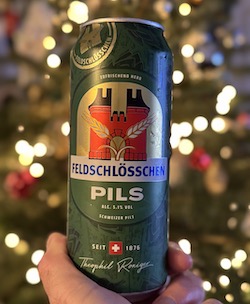
Feldschlösschen Pils
Brewed in a massive castle-like brewery in Aargau, Rheinfelden, this is Switzerland’s largest brewery and the most-consumed beer in the country. Per the website, every fourth glass of beer drank in Switzerland is from the Feldschlösschen brand. The brewery has been around since 1876 and was purchased by the Carlsberg group in 2000. Although it’s now part of a global corporate behemoth, it is still a proud unique Swiss-brewed beer, and it’s unlikely that you’ll find it outside of the Swiss borders. But if you’re in Switzerland, you’ll spot it damn near everywhere – grocery stores, restaurants, train stations. This would likely be the closest to one of our big beers like Bud or Miller (which are also part of large foreign-owned brands) but without all the big beer stigma and drama that I mentioned above.
From my perspective, it offered up more flavor and personality than our big beers in the States that try to appeal to the broadest range of palates and end up rather lifeless. Maybe it’s because Feldschlösschen is brewed locally, maybe it’s because I don’t have the same preconceptions about it that I do with the American macros, or maybe it was just because I was on vacation, but I found it to be easy drinking without being boring.
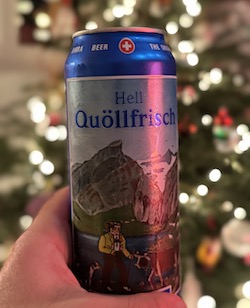
Appenzeller Quöllfrisch
Quöllfrisch is a Helles (or “bright”) style lager, part of the Appenzeller Bier brand which consists of about 45 different beers and beer mixers. It is brewed by Brauerei Locher in Appenzell and has been in operation since 1885, for five family generations. Locher is one of Switzerland’s largest independent breweries (not part of a larger global brand) and its beers are, for the most part, available only within the country. Quöllfrisch remains very popular and is considered one of the better mainstream lagers in the country, even taking home medals at World Beer Competitions.
I really enjoyed the Quöllfrisch and it is probably what I drink most often while I’m over there. I’ve tried some of the other Appenzeller beers like the Glühbier Ginger (spiced winter beer) and the Vollmond Hell (an organic lager brewed only on full nights) and enjoyed them all. Good beer and easy to find!
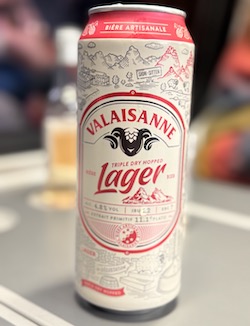
Valaisanne Lager
Brewed by Brasserie Valaisanne, a smaller regional brewery in Valais, Switzerland. Most of the Valaisanne beers are found mainly in the Valais region, but others like the lager are more widely available. It’s a far more modern brewery compared to the old guards and is more of a craft or micro brewery than most of the others on the list. Along with its dry hopped pilsner, Valaisanne offers other styles popular to the craft beer crowd such as a juicy/hazy IPA, pale ale, unfiltered lager, and numerous limited seasonal releases. These guys are continuing to boom in popularity and have picked up some Swiss beer awards along the way.
I grabbed one of these for a train ride and really liked it. A bright and flavorful pilsner that deserves to be poured into a glass, but worked very well as a train beer too.
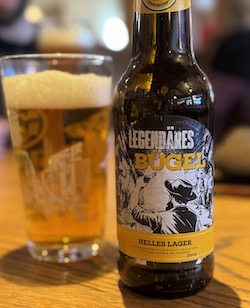
Eichhof Legendäres Bügel
Brewed by Eichhof Brewery, one of the oldest Swiss breweries still in operation, in the Lucern region since 1834. Today it’s owned by Heineken Switzerland but is still brewing locally, with some very popular beers that you’ll find in many Swiss pubs. A medium to large-sized brewery by Swiss standards that distributes nationally but with its strongest presence in central Switzerland (Lucerne, Zug, etc). While it’s a pretty mainstream beer owned by a global company, it’s still regarded as a regional brewery and is a respected, long time brand that the Swiss are proud of. Fun fact – the name for the swing top cap on their bottle is a Bugleverschluss.
I had a Eichhof Legendäres Bügel (a Helles lager) in the ski lodge at the top of the mountain in Engelberg, and it was delicious. I didn’t ski, just had that beer. Hell yeah. This is the beer brand that I tend to order first whenever I see it on a restaurant menu.
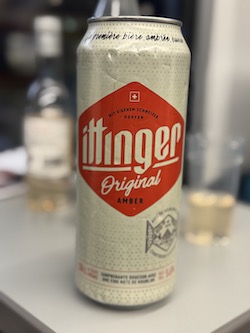
Ittinger Original Amber
This beer brand is associated with Kartause Ittinge, a former Carthusian monastery in Thurgau, promoting its monastic and agricultural history. Traditionally, it was brewed from ingredients grown on the monastery grounds, and while the brewing happens in modern facilities these days, the monastery remains a strong part of its heritage. This is a fairly mainstream beer that we picked up as a six pack at Migros, a popular supermarket chain, and also as a to-go at the station for a train beer. It separates itself from many of the other widely available beers by being an Amber ale rather than the more common pale lager, and prides itself on being Switzerland’s first amber beer. Ittinger also falls under the Heineken Switzerland umbrella, similar to Eichhoff, but still remains a proud local Swiss-brewed beer.
After a steady diet of pale lagers, a well-brewed, easy drinking amber was a nice change of pace. A very solid, tasty beer that I’d happily take with me on the next train trip.
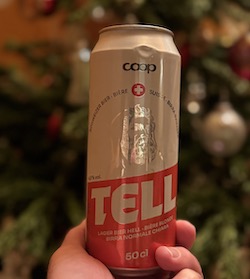
Coop Tell
Coop is one of the main supermarket chains in Switzerland, and Tell is their label beer which is contract brewed by a large Swiss brewery (not sure which one; I guess I could have googled it). This is an affordable, simple, easy drinker that you’ll only find at a Coop store. Basically, a sixer you’d grab while you’re doing your weekly shopping so you’ll have some beer in the fridge, and that’s about as much thinking as you want to do on the subject. No shade on that!
I found it to be a perfectly fine beer. A good one for casually sipping out of the can at the in-laws. I felt like it had far more character than what I’d expect from a grocery store branded beer here in the States… well, with Kirkland beers from Costco being an exception.
Ok, that’s enough on this subject. There were a few more beers that I could have listed, but this feels like a good swath of the readily available, macro-to-regional beers that you’ll find in Switzerland without trying too hard. Next time I’m there, maybe I’ll start looking for some more obscure craft brews. But for now, I’m happy to report that if you’re looking for well-brewed easy drinking proud Swiss-built sluggers, you’ve got plenty of options.
Prost!
(What’d I miss? What’d I miscommunicate? Share your insight in the comments, should you feel so inclined!)


Leave a Reply