
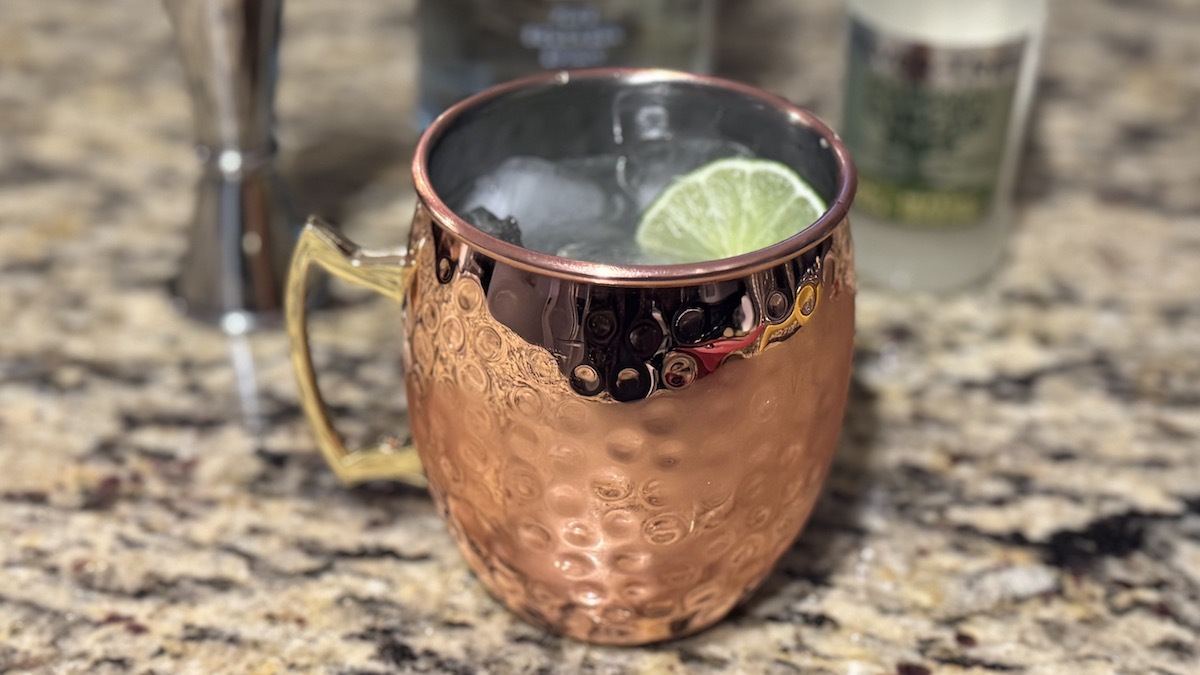
The twelfth entry in the series where my wife Sabrina and I journey through the wide wonderful world of classic cocktails by crafting and drinking recipes together at our home bar. Today let’s discuss the simple, refreshing, and hugely popular concoction that convinced countless consumers to purchase a copper mug, the Moscow Mule.
Recipe:
- 2 oz Old Fourth Distillery Hand Crafted Vodka
- .5 oz Fresh lime juice
- 4 oz Fever Tree Ginger Beer
- Ice
- Garnish: Lime wedge
- Garnich (optional): Mint
Fill up a copper mug (or highball if you don’t have one) all the way to the top with ice. Add vodka and lime juice, and then top with the ginger beer. Give it a quick, gentle stir. Garnish with a lime wedge and optionally, a mint sprig.
Intro:
To be honest, I’ve never had a strong desire to make a Moscow Mule, and I can’t really say why. I enjoy a good ginger beer cocktail and I’m a sucker for a drink that has its own dedicated drinking vessel, so what gives? I have to assume it’s because I still carry a bit of a silly high school punk rock contrarian streak in me, and when Moscow Mules came galloping back into the scene during the 2010s, I may have been performatively perturbed by their popularity. A lousy excuse, but I’m here to share the hard facts with you folks, no matter how much it hurts.
The first thing that comes to mind with a Moscow Mule is, of course, that iconic copper mug. Luckily for me, despite not being a Moscow Mule drinker up to this point, I have a bunch of copper mugs in my bar cabinet anyway. Being the “beer guy” in one’s group of friends means that you’re often generalized as the “drinking guy,” and you receive drinking-related gifts for every holiday, eventually establishing a rather large cache of drinking paraphernalia, merch, tools, party items, and glassware. So when it was time to get behind the Mule*, I was ready.
Throwing Copper:
But is the mug entirely necessary? Eh, not exactly. It certainly does contribute, because copper is a good conductor of temperature, efficiently transferring the cold from the ice throughout the liquid. This keeps the drink colder longer and preserves the carbonation by slowing the egress of CO2 from the ginger beer. Carbonation is an important component of the Mule.
But, it’s also fair to say that the mug is a marketing gimmick, too, considering that there are countless cocktails that incorporate a carbonated liquid and aren’t served in copper. We’ll return to the marketing stuff later.
So, if you don’t have a copper mug on hand, no worries. You can always make your own if you have a very hot open flame furnace and an anvil and you’re ok with ripping the copper wiring out of your A/C unit. Another approach, and one that’s more food safe, would be to use a highball glass. Hell, in my old Mr. Boston Bartender’s Guide, the Moscow Mule recipe says to serve it in a coffee mug. So becoming a metallurgist and forging your own mug or grabbing something out of your kitchen cabinet are both potential options for you to consider.
Speaking of serving vessels, the Moscow Mule is a “built drink”, or a “built over ice” drink, meaning that you build the drink directly in the glass that it’s served in. No need for a cocktail shaker or a mixing glass for this one, making it a great go-to when you want a quick tipple without a lot to clean up.
No shakin, bacon:
But why not shake this one, you might ask. We’ve previously discussed that shaking is most commonly used for drinks with citrus, and you can clearly see with your own damn eyes that this recipe contains lime juice, so what the hell, Bones?
That’s a good question. Also, chill out, bud, we’re all friends here. Shaking a citrus drink is important for a couple of reasons, both which don’t apply to the Mule:
First, we shake a drink to “integrate” ingredients that don’t easily integrate, such as booze and citrus and, mainly, sugar, so that the sweetness is distributed evenly throughout the solution and you don’t end up with a disjointed drink where the sweetness sits at the bottom. We don’t use sugar in a Moscow Mule, and lime and vodka mix just fine without the extra force.
Second, shaking whips air into a drink, creating tiny bubbles that give the drink its lighter, softer body and that “fluffiness” we associate with drinks like sours (think Daquiri, Whiskey Sour, etc). We’re not going for that texture in a Moscow Mule, and instead we’re leaning on the carbonation from the ginger beer for the texture.
Third, speaking of carbonation, if we were to shake all the ingredients, including the ginger beer, we’d pretty much shake all the carbonation right out of the drink (you can test this with a little science experiment: Sit on an expensive piece of furniture, shake up a bottle of soda, and then open the bottle). As I said earlier, carbonation is critical to the Mule, so we want to avoid doing anything to disturb the bubbles, which includes even aggressively stirring it. Just a single little spin of the spoon is plenty.
I just used a lot of text to explain a process that is not needed for this drink, which seems counterintuitive and unnecessary. But since we’re all friends and friends don’t lie, I really couldn’t come up with a lot to say about this drink. It’s a very simple drink. Oh, but actually the history is pretty interesting. So let’s get into that.
Origin Story:
Unlike most of the “classic” drinks that we’ve discussed so far, the Moscow Mule is a fairly young cocktail, having only been around since the 1940s. The story goes something like this:
There was a California liquor distributor, John G. Martin, who was trying to offload a surplus of Smirnoff vodka that his company had recently purchased, back when Americans weren’t really drinking vodka, or even familiar with vodka.
John’s buddy was Jack Morgan, who owned the Cock n’ Bull pub in Los Angeles, and had an overstock of ginger beer that he wanted to get rid of.
AND there was a woman, Sophie Berezinksi, who arrived in the U.S. from Russia with a shipment of copper mugs from her father’s copper company that she wasn’t able to sell back home.
Fate (and probably a bit of poetic license) brought these souls together, each with their excess of product, and along with the cocktail craftsmanship of Cock n’ Bull bartender Wes Smith, they birthed the now legendary drink. Go America.
A fun tidbit for you all you marketing aficionados – To promote the drink, John would use one of those new fangled Polaroid cameras to snap photos of bartenders pouring up a Moscow Mule with Smirnoff vodka and he’d distribute the pics throughout the drinking scene. An early form of guerrilla viral marketing, and hell, influencer culture, I guess. Clearly it worked.
Moscow Mules (and vodka) rapidly gained popularity through the 40s and 50s, and then saw a decline around the 70s when new spirits and trends took over. It then came back with a vengeance in the 2010s as part of the cocktail revolution that introduced a bunch of new “classics”, revitalized many classics of old, and took mixology in general to a new level.
The origin story of the Moscow Mule is a quintessential American tale of creativity, entrepreneurial spirit, and friendship. And, almost certainly, embellishment.
Just about every old cocktail has at least a couple conflicting origin stories, and the Mule is no different. Here’s a great article from VinePair that dives far deeper into the Mule mythology than I’m capable of doing.
Recipe Rationale:
Old Fourth Distillery Hand Crafted Vodka: O4D opened in 2014, becoming the first legal distillery in Atlanta since prohibition. They make fantastic vodka, gin, whiskeys, etc. They were purchased by Shortbarrel Bourbon in 2023 and moved from the city to Norcross, GA, but continue to make their delicious namesake spirits. Check ‘em out!
By the way, the brand of vodka you use is not terribly important, considering that the main player here is the ginger beer. Any mid-priced vodka will do just fine in a Mule. You won’t go wrong with Tito’s or Smirnoff or what else you have on deck, as long as it’s not cheap swill that would detract from the flavor.
Fever Tree Ginger Beer: I usually default to Fever Tree for mixers because they’re high quality, taste great, and available in most grocery stores near me. I saw many recipes online that also called out this brand as being a spot-on ginger beer for Moscow Mules in particular.
Limes: As I always call out, it’s important to squeeze your own citrus for cocktails, and a Mule is no different. In fact, it’s even more vital, as the fresh lime juice brings forth a brightness that is critical for a good Mule, and can’t be achieved with the bottled stuff.
Ice: Cubed ice is better than crushed for this drink, by the way. Crushed ice has much more surface area than cubes, increasing the amount of CO2 that leaves the solution, leading to carbonation loss. Crushed ice also melts quicker, over-diluting a drink that is already plenty diluted by the ginger beer.
Verdict:
“Ginger and lime taste so good together! This drink was really fresh and spicy. I’d have loved to drink a whole one, but it’s Dry January for me, which Bones doesn’t celebrate, so I just took a sample of his. I want one in February.”

Sab
“The ginger beer gave this drink a really vibrant spiciness that made it the star of the show while still playing very nicely with the lime juice. I think an extra 1/4 oz of lime juice wouldn’t hurt to bring the lime forward a bit more, but not critical. Overall, a bright, spicy easy drinker that would go great on a hot summer day instead of the freezing cold winter night when I made it. Speaking of cold, I think this would benefit from smaller ice cubes than the big clunkers in my freezer, but gotta work with I got. I also felt like it tasted a little simple to me, but probably because I knew how simple the recipe actually is. If I didn’t, I might have been more dazzled by it. As far as ginger beer drinks go, I’d still choose a Dark n’ Stormy over a Mule, but it was a tasty concoction nonetheless, and would be a stellar drink in the right setting.”

Bones
Additional Reading:
I found a lot of good information and recipe inspiration from these articles. Give ’em a look!
*With apologies to Tom Waits
Leave a Reply