
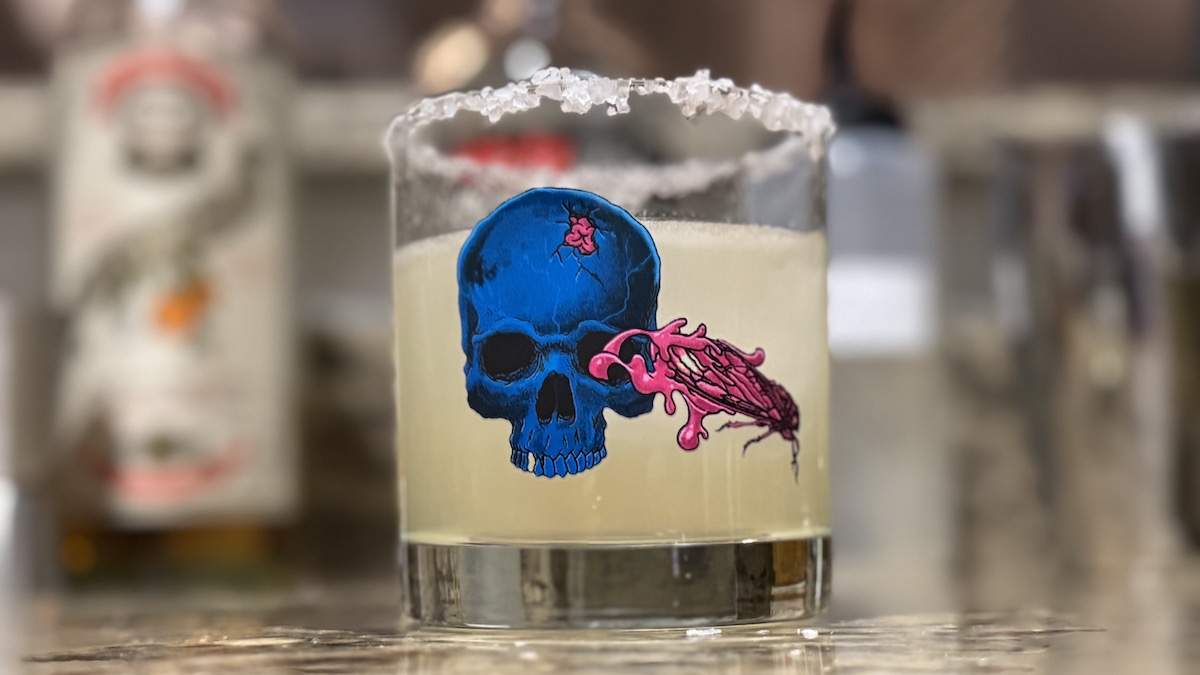
The eleventh entry in the series where my wife Sabrina and I journey through the wide wonderful world of classic cocktails by crafting and drinking recipes together at our home bar. Today let’s take a deep dive into everyone’s favorite tequila delivery system, the legendary margarita.
Recipe:
- 2 oz. Espolon Blanco Tequila
- 3/4 oz. Pierre Ferrand Dry Curacao
- 1 oz. Fresh lime juice
- 1/8 oz. Simple syrup
- Lime wedge
- Salt (kosher or flaky sea salt)
Sprinkle a layer of salt on a small plate. Rub the lime wedge over the rim of an Old Fashioned glass to wet it, and then roll the rim of the glass in the salt to lightly coat the rim. Add the booze, lime juice and simple syrup into a shaker full of ice and shake until cold (approx 10-15 seconds). Strain into the salt-rimmed Old Fashioned glass over a single large ice cube. Optionally, you can use the lime wedge as a garnish if you want, or you can just put it in your pants pocket with your keys and your vape pen.
Intro:
Like a lot of folks, I spent most of my life thinking that there were three kinds of margaritas:
- A sloppy mix of cheap tequila and a sugar-filled neon green sour mix and ice. In a plastic cup with a cactus on it.
- The exact same thing as #1, but frozen.
- The exact same thing as #2, but the sour mix is bright red instead of bright green, transforming it into a “Strawberry Margarita”.
Turns out that a “real” margarita is about as simple as the concoctions above, but far more pure. And, of course, it’s strikingly better in the pure/original format, residing as a standing member of the “sour” cocktail family along with its amigos like the daiquiri, whiskey sour, sidecar, etc. But let’s hold off on the technical stuff for a minute and bask in some alcoholic anecdotery.
Amateur Hour:
In our first year out of college, when Saturday morning rolled around, my buddy would swing by my apartment to pick me up, both of us still steeping in stupendous hangovers from the previous night of being idiots in the late 90s Buckhead party bars. We’d drive to the nearby liquor store to pick up a bottle of cheap rotgut tequila and the cheapest sour mix available, head back to my apartment, mix ourselves the shittiest of shitty margaritas, and then sit outside on crappy shaky lopsided plastic chairs on my back porch on the ground floor that looked out over a vast valley of asphalt parking lot and Honda Accords and was shrouded in a near permanent shadow from the apartment patios above it.
We would proceed to drink our enamel-dissolving neon green poison until our hangovers were gone, and then continue drinking them until we were good and drunk, and then continue until it was time to get ready to head back out to the Buckhead party bars for Saturday night shenanigans. A reasonable man would know he was in no shape to be out in public at this point. We were not reasonable men. We were the Margarita Boyz. That’s what we called ourselves.
Needless to say, the ladiez were most assuredly not into the Margarita Boyz. And thus, this particularly unproductive phase of our lives fizzled out pretty quickly.
Anyway, being a Margarita Boy is one way to explore the world of sour tequila-based cocktails, but now let’s instead engage in a more traditional, and mature, perspective on the popular drink.
Booze Basics:
As mentioned earlier, a margarita can be classified as a sour, a simple cocktail composed of spirit, citrus, and sweetener. In the case of sours like the daiquiri or a whiskey sour, for instance, the sweetener is sugar (or simple syrup). In a margarita, we replace the sugar with an orange liqueur. So, a classic daiquiri is rum, lime, and sugar/simple syrup, and a classic margarita is tequila, lime, and orange liqueur. Pretty cool, right?
But what do we mean by an orange liqueur, exactly? In short, it’s a base spirit that has been flavored with orange peels and sugar. In my old Mr. Boston’s Official Bartender Guide from the 90s, the margarita recipe calls for Triple Sec. Many modern recipes online call for Cointreau specifically. In my recipe above, I used Dry Curacao. All are fine, but it helps to understand the differences between them in flavor, base spirit, and your personal preferences:
- Triple sec (means “Triple dry”): The lighter, sweeter, and most blatantly orange of the orange liqueurs, made from a neutral base spirit. There are a lot of cheap versions of Triple Sec out there, which would explain why it has become the standard orange liqueur in your friendly neighborhood restaurant chain’s margarita recipe.
- Cointreau: Technically, a Triple Sec, but a specific kind of Triple Sec. A cleaner, brighter flavor, and also more neutral and less sweet, than your everyday Triple Sec.
- Dry Curacao: Originally made from oranges from Curacao (thus the name), it’s deeper, drier, more complex, more orange peel-forward than the others, typically from a Brandy base spirit. Not as frequent a contributor to margarita recipes as a Triple Sec or Cointreau, and if you choose to use it, you’ll want to consider the extra dryness it brings.
So, there’s our quick primer on orange liqueurs, but what about tequila? Should you just be like the Margarita Boyz and grab the cheapest stuff on the shelf, ensuring that your next day is spent laid out on the couch with a half-eaten bag of Cheetoh’s on your chest, harboring a hangover forged from the fires of Hades? You certainly could, but here’s some brief notes on tequila types that may help if you should choose to take a more noble path:
- Blanco: This is unaged tequila that has not spent any time in a barrel. It’s going to give you bright, sharp, pure agave flavors. You’ll want to use a blanco tequila if you’re making a classic margarita. And make sure it says “100% Agave” on the bottle, meaning it’s distilled only from pure Agave plants, and not blended with other alcohols to cut costs.
- Reposado (“Rested”): Spends 2-12 months in oak barrels before going in the bottle. Smoother than a blanco, with light vanilla, caramel, and wood notes. You can use this in a margarita, but it will make it warmer and mellower. Still good, but just not as traditional.
- Anejo (“Aged”): Spends 1-3 years in oak barrels before bottling. This is going to be much smoother, richer, and more complex, with much bigger notes of vanilla and caramel. Maybe some tobacco and chocolate. A sipping tequila rather than a cocktail tequila.
- Extra Anejo: Aged over 3 years in oak. More like a fine whiskey or cognac. This is what the big dogs sip on, and they pay the dollars for it.
Ok, we’ve covered the main points about the ingredients and I’ve shared another embarrassing anecdote about my debaucherous days of old, so what am I missing? Ah yes, the history!
Origin Story:
As with most of the classic cocktails, there are differing accounts as to how the margarita came to be. One is that it was invented back in the 30s or 40s in Tijuana, Mexico by a bartender Carlos “Danny” Herrera who threw it together for a customer who was apparently allergic to other spirits. Hmm. Another is that it was invented in late 40s Acapulco by a wealthy socialite named Margarita Sales. Maybe? And the last one, which sounds most legit to me, is that the margarita is just an offshoot of an earlier cocktail, the Daisy, which is also a mix of spirit, citrus and orange liqueur. In Spanish, “margarita” means “daisy flower.”
At any rate, it was likely invented in Mexico and then it grew in popularity throughout the States in the 50s and 60s .
But when did the margarita go from a simple sour to the crazy frozen fruity monstrosities that grace the drink menus of Chilli’s and the like, and are, admittedly, hilariously delicious? Well, a restaurateur from Dallas named Mariano Martinez is credited with inventing the first commercial frozen margarita machine in 1971, and these machines started to become ubiquitous in chain restaurants like Chi-Chis, On The Border, etc throughout the 80s and 90s, where sweetness became the primary driver and all kinds of extra fruit and sugar were added, basically turning this once simple elegant drink into the booze version of Six Flags. That’s how we roll here, I guess.
Recipe Rationale:
Espolon Blanco Tequila: I’m not a tequila aficionado, and I only had a single bottle in my liquor cabinet, which was an Espolon Reposado. I figured that there must have been a good reason why I had previously chosen the Espolon brand, so I picked up an Epsolon Blanco. I’m glad I trusted the past version of myself. The Espolon Blanco worked quite well. But you’ll do fine with any good mid-range tequilla, just make sure you go with a blanco if you want a traditional tasting margarita, and make sure that the bottle says “100% Agave.”
Pierre Ferrand Dry Curacao: As mentioned above, you’ll usually see Triple Sec, and more specially Cointeau, as the orange liqueur of choice for margaritas. And I did have a bottle of cheap Triple Sec in my liquor cabinet, but I also had this nice bottle of Dry Curacao on hand for Mai Tais. I went with the good stuff, understanding that it would be dryer and more orange peely than a Triple Sec. But apparently that’s closer to how the original margaritas tasted anyway, so all was well.
Fresh Lime Juice: As with any citrus-based cocktail, freshly squeezed juice is paramount. If your juice is not fresh, you’re kind of just wasting booze. Grab one of these citrus juicers if you don’t have one, and some fresh limes at the store. If you don’t, you might as well just pick up some pre-made sour mix and give the Margarita Boyz a call.
Simple Syrup: If I had used Triple Sec, I may not have even needed additional sweetener, but I wanted to account for extra dryness of the Dry Curacao. I’ve seen other recipes that call for Agave syrup instead, which apparently gives a bit of extra warmth and roundness and brings forth the tequila a bit more. But the simple syrup worked fine and brightened up the sour lime juice enough to make it interesting.
Verdict:
“This was my second favorite drink we’ve made so far, next to the daiquiri. I guess I like drinks with lime and sweetener. I think this one could have leaned a little bit more towards sour, but I liked that it wasn’t overly tequila-forward. Overall, it was delicious and I could have easily drunk a glass down in about two seconds.”

Sab
“We made two versions. The first used ¾ oz of lime juice and it was good, but just not all that exciting. Upping the lime juice to 1 oz made a big difference. It made the drink much more tart, in a good way, and just tied everything together better, making it a brighter, more memorable drink.”

Leave a Reply