
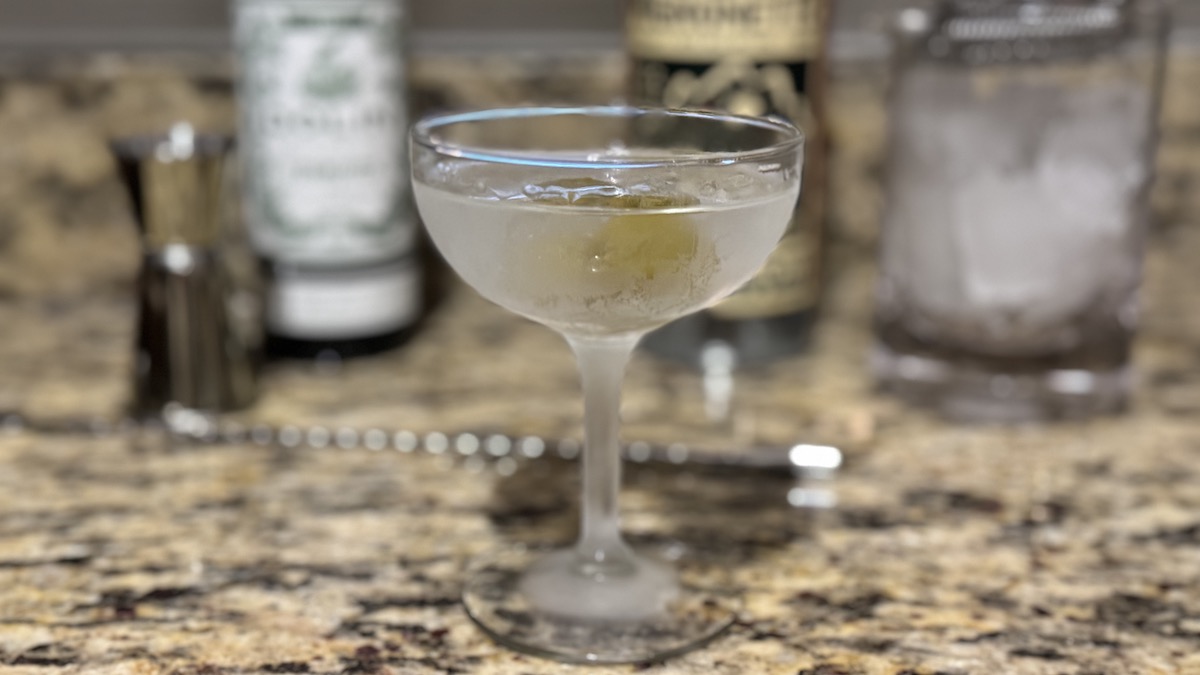
The tenth entry in the series where my wife Sabrina and I journey through the wide wonderful world of classic cocktails by crafting and drinking recipes together at our home bar. Today let’s take a peek at the pinnacle of elegant simplicity, the Martini.
Recipe:
- 2.5 oz Murrell’s Row Gin Mignonette
- 0.5 oz Dolin Dry Vermouth
- Garnish: Olive
Freeze the glassware ahead of time. Add the gin and vermouth to a mixing glass with ice. Stir for about 20 – 25 seconds until cold, allowing for a bit of dilution but not enough to flush it out. Strain into your cold coupe or Nick and Nora glass. Toss in a couple olives or skewer them on something nice like a cocktail pick or maybe a dagger if you’re a real badass.
Intro:
Ahh, the Martini. The timeless symbol of drinking sophistication and class. A beautiful crisp, clean, clear cocktail composed of just 2 ingredients and a simple garnish, ice cold in a stemmed glass, sipped suavely by sophisticates in suits.
Or spilled down the shirt of the sloshed salesman staggering through the steak house.
A true beacon of drinking experience, or lack thereof.
I love a good Martini. But I love to drink them at home. Or, maybe I’ll have one out on the town as my post-dinner drink before hopping in an Uber. I never start my evening with one, though, as one Martini is rarely enough, and more than one is a great way to end up trying to dance with the waitstaff wearing your necktie as a headband*.
It’s not that a Martini is necessarily stronger than a lot of other cocktails, it’s just that it’s too easy to slurp ‘em down too quickly. Maybe it’s the clear color and lack of ice, maybe it’s that a martini glass deceptively makes it look like you’ve still got a lot more in your glass than you do, maybe it’s just that they’re so damn good. Whatever it is, I’ve always looked at the Martini as a barometer of one’s drinking experience. When someone orders their third martini, you can be sure that they’re either a hardened drinker who knows what a third martini can do to (or for) you, or they’re a drinking neophyte who ordered one of the few cocktails that they know by name, got overly excited about it, and will be apologizing to their spouse tomorrow.
Ok, that’s enough self-indulgent verbosity for now (kidding, there’s plenty more coming). Let’s take a minute to dissect the Martini.
A classic Martini consists of just two ingredients – gin or vodka and dry vermouth. Garnished with an olive or a lemon twist (ie twisted up lemon peel). Served cold in a cold stemmed glass. That’s it. It’s up to the imbiber to work with these minimal variables to construct the drink that’s perfect for him or her. As you would expect, with so few rules, it presents us ornery humans a perfect platform to scream at each other about the rules.
Let’s discuss civilly, shall we?
Vodka or Gin?
This is the one where folks get most heated, usually those on Team Gin, claiming that the spirit of a martini comes from the botanicals in the gin and so there’s no point in using a “flavorless” spirit like vodka. That’s not very nice. Vodka, of course, does have flavor, and I’m not referring to the colorful fruit flavored party vodkas that so nicely complement an ice luge.

Vodka drinkers appreciate the delicateness and subtleties in the spirit, which I might haphazardly compare to those of us beer drinkers who love a good clean delicate pilsner. Nonetheless, I’m a gin guy. I remember my parents sipping on a Martini and explaining that a “true Martini is a gin Martini” back in the 80s and that stuck with me. My parents told me a lot of other things about a lot of things which thankfully did not stick with me, so I’m not sure why the gin thing did, but it did, and I’m glad.
Olive or Lemon Twist?
Is it me, or does the lemon twist seem to be the more popular Martini garnish these days? Perhaps due to the prevalence of vodka Martinis? I always thought of the olive as the “classic” Martini garnish, but maybe that’s because my parents would put olives in their Martinis, and they’d let me eat one after they’d emptied their glass, because in the 80s, kids could do whatever the hell they wanted. My parents probably would have let me dip Skoal had I thought to ask. Oh shit, it just dawned on me that this is probably why I love gin (and every other spirit) now! Because I was sucking down gin-soaked olives when I was just an impressionable youngster! Well, I know what excuse I’m going to use for all my stupid alcohol hijinks from the past 30 years.
For what it’s worth, “expressing” a lemon peel over a Martini does give it a very nice faint lemon essence, which I would probably enjoy if it weren’t for that whole gin-fueled childhood thing.
5:1 or 3:1?
I’ve seen a lot of articles stating that a true Martini has a 5:1 proportion, meaning 5 parts gin/vodka to 1 part vermouth, and they’re pretty damn stern about it. I’ve seen others who claim that a Martini must be 3:1, which is also what it says in the classic Savoy Cocktail Book. The one true proportion for a Martini, however, is whatever works for you. You can make it 5:1, 3:1, 4:1, 6:9, whatever the hell you want. I’m not being a performative nice guy here either, Martinis are laissez faire when it comes to proportions.
(And how about that 69 joke I just slipped in there? Do you respect me for that?)
The recipe I used and posted above is 5:1, by the way. Not because some Proportions Hall Monitor told me too, but because I liked it that way.
Shaken or Stirred?
While doing my Martini research, I discovered something interesting. There seems to be some unwritten rule that decrees that if you write about a Martini, you must opine on how James Bond orders his Martinis “shaken, not stirred.” So here goes…
A Martini is supposed to be stirred. It’s meant to be clear and clean, and if you shake it over ice you’ll cloud it, over dilute it, and add little specks of ice in it. Of course, if you like it that way, then hell, drink it that way. Apparently James Bond liked it that way too, so you’re in good company.
But I like to think that James Bond creator Ian Flemming was just an old school version of a troll. He knew that Martinis are supposed to be stirred, so he made James Bond order them shaken just to piss off the cocktail snobs for decades to come. Pretty sweet move.
I’d like to think the Eagles were playing a similar troll game with their infamous Hotel California line, “So I called up the Captain. ‘Please bring me my wine’. He said, ‘We haven’t had that spirit here since 1969.’”
Wine ain’t a spirit, bro! How dare you! But, nice 69 joke that you slipped in there. Respect.
For what it’s worth, at a very high level, shaking is for drinks with citrus in them and stirring is for non-citrus, often booze-only drinks.
Is this article almost over?
No it’s not, and I apologize. So many words, and so little actual information. Ok, here’s your brief historical tidbit:
You may assume that the Martini, being such a simple recipe, was the first spirit/vermouth cocktail, but there were many before it. The Martinez (gin/sweet vermouth/maraschino liquor/bitters) and the Manhattan (whiskey/sweet vermouth/bitters) are a couple examples. In fact, the first printed recipe for a Martini was back in the 1880s, but it was closer to the Martinez than the Martini that we know and love today. The current “classic” version of the Martini first appeared in the Knickerbocker Hotel in New York 1911 or so.
Recipe Rationale:
Murrell’s Row Gin Mignonette: This is the gin that my favorite distiller designed for being made into a Martini and served with oysters. It’s layered, smooth, botanical and savory. Delicious stuff. It’s local to Georgia, but if you’re not here, you can order it online. I always have a bottle of Murrell’s Row Gin Gin in my liquor cabinet, but I picked up a bottle of Mignonette specifically to make a Martini.
If you need to pick up something more widely available, there are a few things to keep in mind:
How “bold” do you want it? For a more Juniper-forward taste, you can go with Tanqueray or Beefeater. If you prefer something softer or more “balanced”, Bombay Sapphire or Plymouth should do the trick.
With the “bolder” gins you can probably handle a little extra vermouth, but you’ll of course need to keep in mind the boldness of the vermouth, too. Lighter/softer gins will play better with a lighter vermouth, for instance.
Dolin Dry Vermouth: Dolin is a lighter, slightly less herbal vermouth which should keep the Martini from being too sharp. The Murrell’s Row Gin Mignonette could handle a bolder vermouth, I’d think, but I was fine with Dolin since I wanted the gin to be the major player here. Not to mention, Dolin is the brand that I always have in the fridge.
Quick note that vermouth is an aromatized wine (I go into that a little bit more in my Manhattan post) so remember that it starts to oxidize as soon as you open it, giving it a shorter shelf-life than a spirit. Some say it will last in your fridge for up to 3 months, while others say it’s far less, not expecting it to last much longer than a regular ole’ wine.
Olive: I already discussed the whole olive garnish thing above. No need to rehash the fact that I was slurping gin out of olives as a youth back in the crazy 80s while all the squares were slurping Capri Sun and watching episodes of Small Wonder.
Verdict:
“Yow! Both recipes that we made tasted pretty strong for me. They were both good, but I did need to add some olive brine to mine to dirty it up. I think I’m a vodka Martini girl.”

Sab
“Vodka martini? Sacriliedge, Sab! Just kidding. This was a delicious Martini for my tastes. Along with the recipe that I posted above, we also tried an even drier one with 3 oz gin and .25 oz vermouth, and that was wonderful to me as well. Can’t say if I liked one more than the other. The first recipe was a bit softer, while the drier one was bolder and pretty significantly more gin-forward as expected. I would make either one again. Most likely very soon. But I’ll make a vodka one for Sab cause I’m such a sweetheart. We don’t have Nick & Nora glasses so we just used our coup glasses, which were fine. More importantly, we remembered to put them in the freezer ahead of time. An ice cold Martini in an ice cold glass is world class.”

Bones
*Disclaimer: I’ve never tried to dance with the waitstaff wearing a necktie as a headband after too many Martinis, by the way. I’m a better Martini drinker than this. I did slow dance with a Waffle House waitress at 2am in the Waffle House dining room, though, but this was after too many beers, not Martinis. And I wasn’t wearing a tie.
Leave a Reply