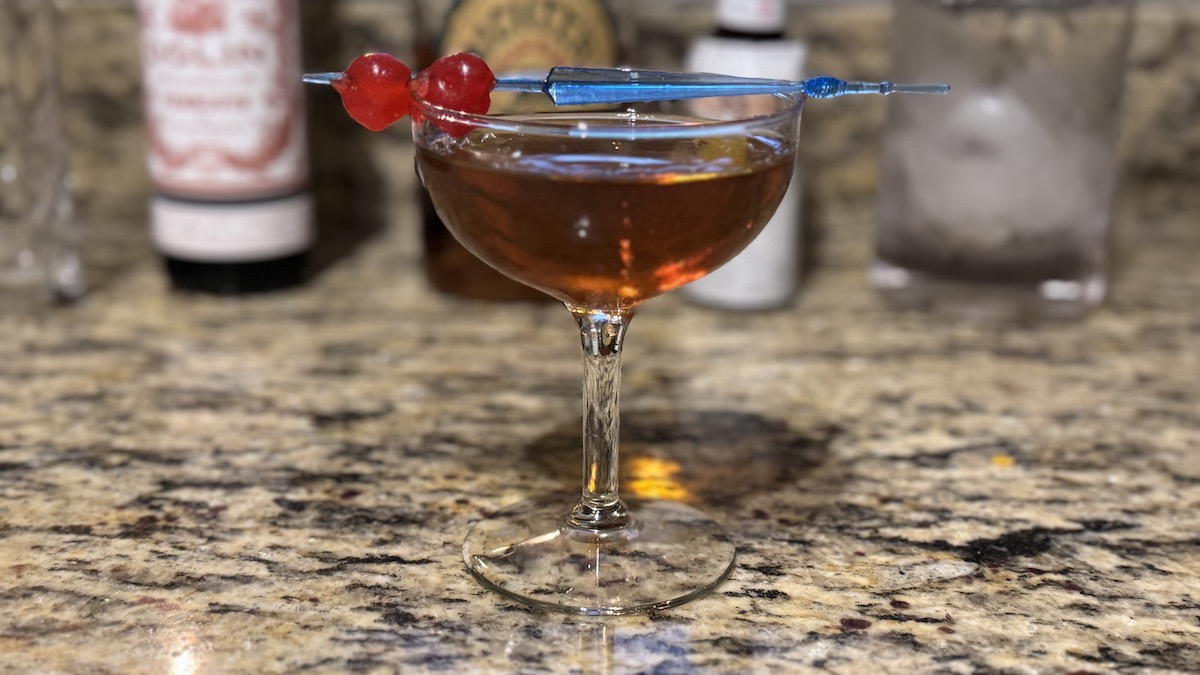
The ninth entry in the series where my wife Sabrina and I journey through the wide wonderful world of classic cocktails by crafting and drinking recipes together at our home bar. Today let’s break out the rye and explore the long-running boozy beauty, the Manhattan.
Recipe:
- 2 oz Michter’s Rye US1 Single Barrel Straight Rye
- 1 oz Dolin Sweet Vermouth
- 2 dashes Angostura bitters
- Garnish: Maraschino cherry
Add the ingredients to a mixing glass half-filled with ice. Stir until cold, approx. 20 – 30 seconds. Strain into a chilled coupe. Garnish with a maraschino cherry or two.
Intro:
I’m pretty sure my first Manhattan was not that long ago, sometime during those days when I was slowly transitioning from my nothing-but-craft-beer-and-homebrew dogma to an awakening into the joys of the spirit world. Sabrina made me a Manhattan out of the blue and I experienced a late-to-the-game epiphany that whiskey and sweet vermouth are an awesome pair.
Prior to that, my only real experience with vermouth itself would have been in a Martini or Negroni.
Oh yeah, and that one time in high school where my buddy and I, after housing a ridiculous amount of Crystal Light and vodka, swiped a random bottle from his parents’ liquor cabinet which turned out to be vermouth, pounded the whole thing, spent the night barfing, and spent the next day suffering through our first true hangovers. Decades later and I still can’t drink Crystal Light without gagging. Vermouth goes down just fine, fortunatley.
On the topic of Martinis, in the Cocktail Codex book (which I have referenced a lot lately because it’s very good), the guys classify a Manhattan as being part of the extended Martini family, and they break down a classic Martini simply as “composed of alcohol and aromatized wine, typically gin or vodka and dry vermouth.” So a Manhattan could be viewed as a Martini offshoot with the alcohol swapped from gin to whiskey and the aromatized wine swapped from dry vermouth to sweet vermouth, as the sweetness and richness of the sweet vermouth is needed to balance out the aged, higher proof whiskey. You also throw in some bitters to serve as the connecting threads between the strong and the sweet, but still, technically you’re following the Martini template of spirit and aromatized wine.
(An aromatized wine, by the way, is a wine flavored with aromatic herbs and spices. Many aromatised wines, such as vermouth, also have distilled spirit added, thereby making it a “fortified” wine, as well.)
There’s another camp out there that views the Manhattan as an extension of an Old Fashioned rather than a Martini. An Old Fashioned consists of whiskey, sugar, and bitters, following the template of spirit, sweet, bitter. The Manhattan recipe does indeed follow the same pattern, but with the sweetener changed to sweet vermouth. Thus a Manhattan could be described simply as an Old Fashioned with sweet vermouth instead of sugar.
It’s an interesting debate, if you can call it that, and it’s a debate that surely would not benefit from my weak attempt to contribute. I’m just another guy rabbit holing around on the internet getting excited about nerdy booze semantics, and who is fortunate that no one reads his blog so he won’t receive a storm of comments after every post telling him that he’s totally wrong, doesn’t know shit about the cocktail world, and/or should cut his hair cause he’s 50 years old now, for Christ’s sake.
Speaking of fun and nerdy debates, similar to the fiery exchanges that go on in the Old Fashioned world (apologies for the hyperbole), many drinkers have strong beliefs in what kind of whiskey belongs in a Manhattan. Rye whiskey is, for the most part, the mainstay of modern day Manhattans, but a lot of folks out there insist that it’s bourbon. The classic Savoy Cocktail book contains a recipe that uses rye (ok, case closed!) and another one with Canadian whisky (well shit…).
History is always spotty with these old drinks, but according to my few minutes of research, it looks like the Manhattan recipe originated as a rye drink, and then it went through a Canadian whisky phase in the mid 1900s as rye became less popular and/or harder to acquire, and then later when bourbon began to grow in popularity, bourbon became the main contender. At some point later, rye crawled its way back to the top.
If you understand my info to be flawed, that is fine. Please feel free to correct me in the comments and call me a hack historian with a bad ponytail because, unlike much of cocktail history, that is an incontrovertible fact.
While we’re on the subject of spotty history, a brief origin story of the drink itself is in order, and it goes something like this: The Manhattan is one of our oldest documented cocktails, having been around since the 1880s, introduced in New York City’s Manhattan Club by a guy named Dr. Iain Marshall.
But, of course, this origin story needs the same disclaimer as so many other classic cocktails that it is not necessarily confirmed and there are other origin stories that conflict with this one. So there’s that. And also I’m a hack historian with a bad ponytail.
Recipe Rationale:
Michter’s Rye US1 Single Barrel Straight Rye: This is the bottle of rye that I had on hand so I went with it. I don’t know a lot about rye, but I know that I like Richter’s a lot. You could certainly go with other, maybe lower-priced ryes if you prefer, and I’ve seen a few Manhattan recipes that recommend Rittenhouse, so you might give that a try. But Michter’s is great stuff.
I very much enjoyed the drink as a rye-based cocktail, but as I blathered about above, there’s nothing stopping you from going with another type of whiskey (or whisky), and history has your back. Stick with rye if you like it dry and a bit spicy. If you want it sweeter and mellowed out, try bourbon. Or go with Canadian whisky for a smoother drink, and to throw fire on the ongoing rye vs. bourbon debate.
Dolin Sweet Vermouth: Dolin is currently the only vermouth I use, mainly because I like it and I haven’t taken the time to really explore the world of vermouth (on my list to do so). For my palate, this played quite nicely with the Michter’s, considering that it’s supposed to be a fairly light and sweet vermouth to go up against the spiciness of rye.
Angostura Bitters: Some folks like to include a dash or two from another brand, or even swap out the Angostura for another brand entirely, but for my classic drinks, I remain an Angostura stalwart. Always good to have a bottle of Angostura on hand, and it’s easy to find at most grocery stores.
Maraschino Cherry: I recommend using Luxardo cherries if you can find them and don’t mind throwing down some money on cherries. Admittedly, for this drink I made, I just pulled from a jar of cheap crap from the grocery store that was already in my fridge, and my regrettable cheap skatery did not go unnoticed in the drink.
Verdict:
“Out of the two recipes we made (see Bones’s comment), I liked the one that was more rye-forward because it was smoother drinking to me, but I thought both were good. Between the Manhattan and the Old Fashioned that we previously made, though, I’d choose the Old Fashioned.”

Sab
“We made two drinks, one with the standard 2:1 proportions that I posted above, and another where we dialed up the bourbon to 2.25 oz and dialed down the vermouth to .75 oz. The motivation for the second recipe was to try to sharpen it up and dry it out a little, accounting for Dolin being a sweeter vermouth than some of the other brands. The second recipe, as expected, had much more focus on the rye, while the traditional 2:1 was more balanced overall. Both tasted very good and I’d be happy with either, but I’d lean just a little more to the traditional 2:1 because it felt a little more “on purpose.” I really like this drink but it’s critical that I step up my maraschino cherry game before I make it another.”

Leave a Reply